Ever looked at words like ‘dangerous’, ‘curious’, or ‘famous’ and wondered why they all sound similar? That shared ending is no accident.
The ‘-ous’ suffix meaning is one of the most useful grammar patterns in English, and once you understand it, hundreds of words suddenly become easier to decode.
Why does this matter in 2026? Because vocabulary skills still power school success, job communication, reading comprehension, and even AI-era writing tools.
If you know how suffixes work, you can understand unfamiliar words faster and speak more confidently.
In this guide, you’ll learn what the ‘ous’ suffix meaning really is, where it came from, how to use it, common examples, mistakes to avoid, and smart ways to remember it.
Updated for 2026 and written for real humans, not grammar robots.
What Does ‘OUS’ Mean?
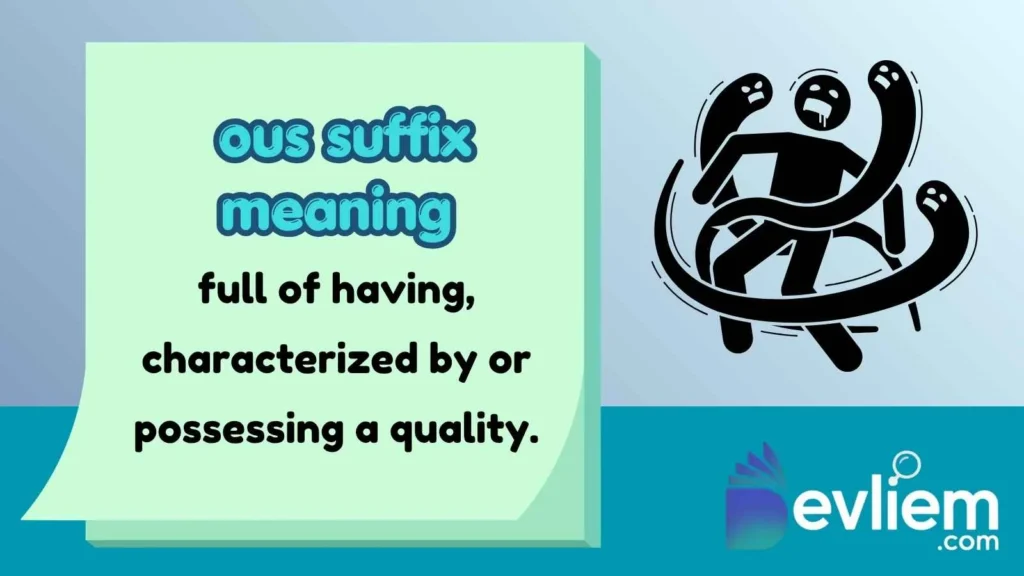
Quick Answer: The suffix ‘OUS’ usually means ‘full of‘, ‘having’, ‘characterised by’, or ‘possessing a quality’.
It is added to the end of a noun or root word to create an adjective.
Examples:
- Danger → Dangerous = full of danger
- Fame → Famous = having fame
- Nerve → Nervous = characterized by nerves or anxiety
- Poison → Poisonous = containing poison
Origin of the ‘OUS’ Suffix
The suffix OUS comes from Latin endings such as “-osus”, which meant “full of” or “abounding in”. Over time, English adopted many Latin and French words using this ending.
That’s why many academic, descriptive, and formal adjectives end in -ous.
Pronunciation Guide
Usually pronounced like:
- uhs → dangerous
- us → famous
- ee-us in some longer forms → curious
English loves chaos, so pronunciation varies a bit.
How to Use “OUS” Correctly in Writing & Speech
The ‘-ous’ suffix meaning helps turn things into descriptive words. These words are mostly adjectives, meaning they describe people, objects, feelings, or situations.
Common Uses
Use ‘OUS’ words when describing:
- Personality: nervous, curious, gracious
- Situations: dangerous, disastrous
- Reputation: famous, infamous
- Feelings: joyous, anxious
Examples in Sentences
- The road was dangerous after the storm.
- She is very curious about science.
- That singer became famous overnight.
- He felt nervous before the exam.
When NOT to Overuse Them
Some writers stack too many descriptive adjectives.
Bad: The mysterious, dangerous, nervous, curious cat stared at me.
Better: The curious cat stared at me.
Capitalization Tips
‘OUS’ words are regular adjectives, so lowercase them unless they begin a sentence.
Real Conversation Examples Using “OUS” Words
Between Friends
A: Why are you checking my phone?
B: I’m just curious.
Meaning: ‘Curious’ shows interest, not hostility.
Family Setting
Mom: Be careful on that wet floor.
Kid: Is it really that dangerous?
Meaning: Dangerous signals are a risk.
School Scenario
Teacher: You look nervous before the speech.
Student: I definitely am.
Meaning: ‘Nervous’ describes anxiety.
Social Media Chat
User 1: That creator got famous fast.
User 2: Seriously. One video, and now they’re famous.
Meaning: Famous means widely known.
Celebration Context
Friend: You passed the exam!
You: I’m absolutely joyous.
Meaning: ‘Joyous’ expresses happiness in a stronger tone.
Common Mistakes & Misunderstandings
1. Thinking ‘OUS’ Is a Standalone Word
‘OUS’ is not a word by itself in grammar here. It is a suffix added to another word.
2. Assuming It Always Means “Full Of”
Usually yes—but not always exactly. Sometimes it means “having qualities of”.
Example:
- Famous = known by many people
Not literally “full of fame”.
3. Spelling Errors
People often confuse the following:
- curious → curius ❌
- nervous → nervious ❌
- poisonous → poisonous ❌
The -ous spelling stays consistent.
Generational Confusion
Students may know suffixes from school, while adults often recognise the words but never learnt the pattern. Same knowledge, different packaging.
“OUS” Across Different Platforms & Demographics
In Schools
Teachers use ‘OUS’ words for phonics, spelling, and vocabulary lessons.
In Professional Writing
OUS words appear often in emails, reports, and formal communication.
- serious
- cautious
- generous
- hazardous
In Everyday Speech
Words like nervous, famous, curious, and dangerous are common across all ages.
Is It Formal or Informal?
Neither. It depends on the word.
- Famous = neutral
- Joyous = slightly formal
- Nervous = everyday casual
- Hazardous = formal/workplace tone
Related Slang, Abbreviations & Alternatives
While ous suffix meaning is grammar-based rather than slang, these related suffixes help build vocabulary:
| Suffix | Meaning | Example |
|---|---|---|
| -ful | full of | helpful |
| -less | without | careless |
| -ive | having nature of | active |
| -al | relating to | natural |
| -ic | related to | poetic |
| -able | capable of | readable |
| -ish | somewhat like | childish |
| -y | full of | rainy |
| -ent | being | different |
| -ary | connected to | legendary |
You can also learn more about prefix meaning, ed suffix meaning, or ly suffix meaning for deeper grammar mastery.
FAQs:
What does OUS mean in English?
The suffix OUS usually means full of, having, or characterized by a quality. It creates adjectives like dangerous, curious, and famous.
Is OUS Greek or Latin?
Most OUS words entered English through Latin roots, often through French.
What part of speech is OUS?
OUS helps create adjectives, which describe nouns.
What are 10 words ending in OUS?
Dangerous, famous, nervous, joyous, poisonous, curious, gracious, serious, cautious, enormous.
How can I remember the OUS suffix meaning?
Think: OUS describes what something is like. If a word ends in OUS, it often describes a quality.
Conclusion:
The ous suffix meaning is simple once you spot the pattern: it usually means full of, having, or showing a quality.
That means words like dangerous, nervous, curious, and famous become much easier to understand instantly.
Master suffixes like OUS, and your vocabulary grows faster with less memorizing. Smart shortcut, right?
Drop your favourite OUS word in the comments below and explore more grammar guides next.

Hi, I’m Emily Taylor, the voice behind Devliem.com, where meanings aren’t just explained, they’re made easy to understand.
I’ve always been fascinated by words, the way they change, evolve, and sometimes confuse us more than they should. That curiosity turned into a mission: to break down complex meanings, trending slang, and everyday expressions into something clear, simple, and actually useful.