Ever heard someone say, “That professor lives in an ivory tower,” and wondered what they actually meant?
You’re not alone. The phrase “ivory tower meaning” keeps showing up in news articles, political debates, TikTok commentary, Reddit threads, and everyday conversations.
It’s one of those expressions people casually throw around but many don’t fully understand.
In simple terms, an ivory tower is a place of intellectual isolation.
It describes people who seem disconnected from real-world problems because they spend most of their time focused on theory, ideas, or privilege.
But there’s more to the phrase than just “smart people acting snobby.”
The meaning has evolved over time, and today it carries cultural, political, and even internet-era undertones
Let’s decode it.
What Does “Ivory Tower” Mean?
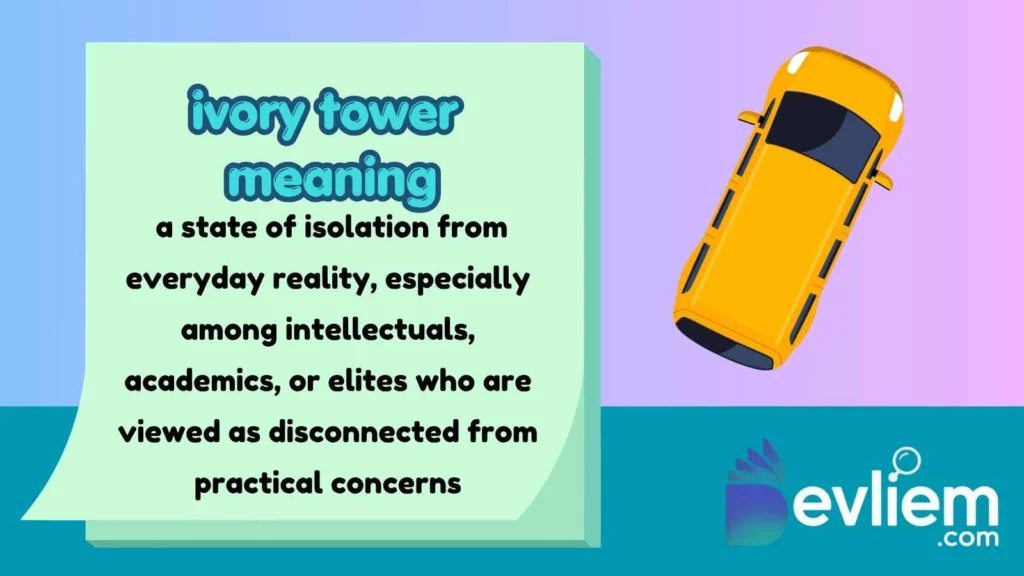
Quick Answer: An “ivory tower” refers to a state of isolation from everyday reality, especially among intellectuals, academics, or elites who are viewed as disconnected from practical concerns.
The phrase usually carries a negative tone. If someone says a person is “living in an ivory tower,” they mean that person is out of touch with how ordinary people live.
Simple Definition
An ivory tower is:
- A sheltered intellectual environment
- A place removed from real-world struggles
- A mindset focused more on theory than reality
Origin of the Phrase
The term actually dates back centuries.
Originally, “ivory tower” appeared in religious writings as a symbol of purity and beauty. Later, French writer Charles-Augustin Sainte-Beuve used it in the 1800s to describe poets who separated themselves from society.
By the 20th century, the phrase became strongly linked to universities and academia. Critics used it to describe scholars who focused heavily on abstract theories while ignoring practical issues.
Today, the expression appears everywhere from political speeches to social media debates.
Pronunciation Guide
Ivory Tower
Pronounced: EYE-vuh-ree TOW-er
How the Meaning Evolved
Back then, the phrase mostly targeted poets and philosophers.
Now? It applies to:
- Politicians
- Tech billionaires
- Corporate executives
- Professors
- Social commentators
- Influencers who seem disconnected from everyday reality
The modern internet has made the term even more popular because people constantly debate privilege, elitism, and “being out of touch.”
How to Use “Ivory Tower” Correctly in Texts & Chat
The phrase is usually used critically, sarcastically, or humorously.
It’s not internet slang like “LOL” or “FR,” but it still appears regularly in digital conversations.
Common Tone & Context
People use “ivory tower” when they want to say someone:
- Doesn’t understand real-life struggles
- Speaks only from theory
- Lives with privilege or isolation
- Gives unrealistic advice
Example Tone
- Sarcastic
- Political
- Intellectual
- Frustrated
- Mocking
Platform-Specific Usage
SMS & WhatsApp
Usually appears in debates or serious conversations.
Example:
“Easy for him to say from his ivory tower.”
Instagram & TikTok
Often used in captions criticizing celebrities, influencers, or wealthy people.
Example:
“Another ivory tower take from a millionaire influencer.”
X (Twitter)
Very common in political arguments and social commentary.
Example:
“Academics in their ivory towers don’t understand working-class realities.”
Discord & Reddit
Used in debates about gaming, technology, economics, or culture.
Example:
“That’s such an ivory tower opinion. Most people can’t afford that.”
When NOT to Use It
Avoid using “ivory tower” in:
- Professional emails
- Formal workplace communication
- Academic papers unless analyzing the phrase
- Sensitive personal conflicts
Calling someone “ivory tower” can sound insulting or dismissive.
Formatting Tips
People usually write it:
- Lowercase: ivory tower
- As part of a phrase:
- “living in an ivory tower”
- “an ivory tower mindset”
- “ivory tower academics”
Emoji pairings online:
- 🏛️
- 🤓
- ☕
- 💸
- 🙄
Real Conversation Examples Using “Ivory Tower”
Between Friends
Alex: “My professor said students should just work unpaid internships.”
Maya: “That’s such an ivory tower opinion.”
Emotional Meaning
Maya thinks the professor is disconnected from financial reality.
In a Group Chat
Sam: “This billionaire says people should stop buying coffee to save money.”
Jordan: “Classic ivory tower advice.”
Emotional Meaning
Jordan sees the advice as unrealistic and privileged.
Dating Conversation
Taylor: “My date kept talking about philosophy but had zero practical life skills.”
Chris: “Sounds like an ivory tower genius.”
Emotional Meaning
Used humorously to describe someone overly theoretical.
Workplace Chat
Employee: “Management wants us to increase productivity without hiring anyone.”
Coworker: “Another ivory tower strategy from corporate.”
Emotional Meaning
The speaker feels leadership doesn’t understand day-to-day work challenges.
Gaming Discord
Player 1: “The devs think everyone has 10 hours a day to grind.”
Player 2: “That’s an ivory tower design philosophy.”
Emotional Meaning
The phrase criticizes unrealistic expectations from developers.
Common Mistakes & Misunderstandings
1. Thinking It Only Refers to Universities
Yes, the phrase is closely tied to academia — but it’s much broader now.
People also use it for:
- Politicians
- CEOs
- Celebrities
- Wealthy influencers
- Media personalities
2. Assuming It Means “Smart”
Not exactly.
Calling someone “ivory tower” isn’t really praising intelligence. It suggests intellectual isolation or lack of practical awareness.
A brilliant person can still be grounded.
An ivory tower person is seen as detached.
3. Using It in Formal Situations
This phrase can sound judgmental.
Saying:
“Your ivory tower perspective…”
…during a work meeting probably won’t go over well.
It’s safer in casual discussion, commentary, or opinion-based conversations.
Generational Misunderstandings
Older Generations
Often associate the phrase mainly with professors or intellectual elites.
Gen Z & Millennials
Use it more broadly online for:
- Privileged takes
- Out-of-touch influencers
- Unrealistic life advice
Cultural Differences
In Western political discussions, “ivory tower” often relates to:
- Academia
- Economic privilege
- Social elitism
In some cultures, the phrase is less common and may confuse non-native English speakers.
“Ivory Tower” Across Different Platforms & Demographics
Gen Z Usage
Gen Z frequently uses the phrase sarcastically online.
Especially on TikTok and X, it’s tied to:
- Privilege discourse
- Wealth inequality
- “Out-of-touch” commentary
Example:
“This is the most ivory tower fitness advice ever.”
Millennials
Millennials often use it in:
- Workplace discussions
- Political commentary
- Critiques of corporate culture
Older Generations
Older users still associate the term heavily with universities and intellectualism.
You’ll often hear:
“Ivory tower academics.”
Is It Formal or Informal?
The phrase sits in a middle zone.
It’s:
- Common in journalism
- Accepted in opinion writing
- Informal in conversation
- Slightly confrontational socially
It’s generally safe for work in professional commentary, but tone matters.
Viral & Modern Usage
The phrase gained renewed popularity during:
- Remote work debates
- Economic discussions
- Political polarization online
- Social media criticism of elites
Modern internet culture loves calling out “out-of-touch takes,” and “ivory tower” fits perfectly into that trend.
Related Slang, Abbreviations & Alternatives
| Term | Meaning |
|---|---|
| Out of touch | Disconnected from reality |
| Elitist | Acting superior because of status or education |
| Bubble | Living in a sheltered environment |
| Echo chamber | Only hearing similar opinions |
| Keyboard warrior | Someone who argues online without real-world action |
| Armchair expert | A person giving opinions without experience |
| Privileged take | Opinion shaped by wealth or comfort |
| Detached | Emotionally or socially disconnected |
| Snob | Someone who looks down on others |
| Think tank mentality | Overly theoretical problem-solving |
Similar Expressions
- “Living in a bubble”
- “Disconnected from reality”
- “Too academic”
- “Preaching from above”
Opposite Ideas
- Down-to-earth
- Practical
- Street-smart
- Grounded
FAQs:
What does ivory tower mean in simple words?
An ivory tower describes a person or environment disconnected from everyday reality. It usually refers to intellectuals, elites, or professionals who seem isolated from practical concerns.
Is ivory tower always negative?
Mostly, yes. The phrase often criticizes people for being unrealistic, privileged, or disconnected. However, some people use it neutrally to describe highly academic environments.
Why is academia called an ivory tower?
Universities became associated with “ivory tower” because critics believed some scholars focused too much on theory and ignored real-world problems.
Can you call someone an ivory tower person?
Yes, but it may sound insulting. It implies the person lacks practical understanding or real-life awareness.
Example:
“He has an ivory tower perspective on economics.”
Is ivory tower still commonly used in 2026?
Absolutely. The phrase remains popular in politics, media, workplace discussions, and social media debates — especially when criticizing “out-of-touch” opinions.
ConclusionL
The phrase ivory tower meaning goes far beyond old academic stereotypes. Today, it’s a powerful cultural expression used to describe people who seem disconnected from everyday struggles and practical reality.
Whether it’s aimed at professors, politicians, influencers, or executives, the phrase usually carries the same core message:
“You don’t fully understand what ordinary people deal with.”
And honestly? In the age of social media, that accusation shows up everywhere.
Now that you know how the term works, you’ll spot it instantly in online debates, news articles, memes, and conversations.
Got a favorite slang phrase or internet expression you want decoded next? Drop it in the comments and keep exploring modern language trends.

Hi, I’m Emily Taylor, the voice behind Devliem.com, where meanings aren’t just explained, they’re made easy to understand.
I’ve always been fascinated by words, the way they change, evolve, and sometimes confuse us more than they should. That curiosity turned into a mission: to break down complex meanings, trending slang, and everyday expressions into something clear, simple, and actually useful.