Ever read a text message that simply says Fine. No emoji. No punctuation. Just fine. You instantly start guessing what it really means.
That guess? That’s inference in action.
Inferences meaning is one of the most searched language concepts because people hear it in school, reading lessons, psychology, workplace communication, and everyday conversations.
It sounds academic, but you already use it constantly when reading tone, spotting clues, or figuring out what someone really means.
Whether you’re a student, parent, teacher, English learner, or just curious, understanding inferences can sharpen communication and critical thinking fast.
In this updated 2026 guide, you’ll learn the exact meaning of inferences, where the term comes from, how to use it correctly, examples from real life, common mistakes, and why it matters more than ever in a world full of subtle messages.
What Does “Inferences” Mean?
Inferences are conclusions drawn from evidence, reasoning, and context rather than direct statements.
If someone doesn’t say something openly, but clues suggest it, you make an inference.
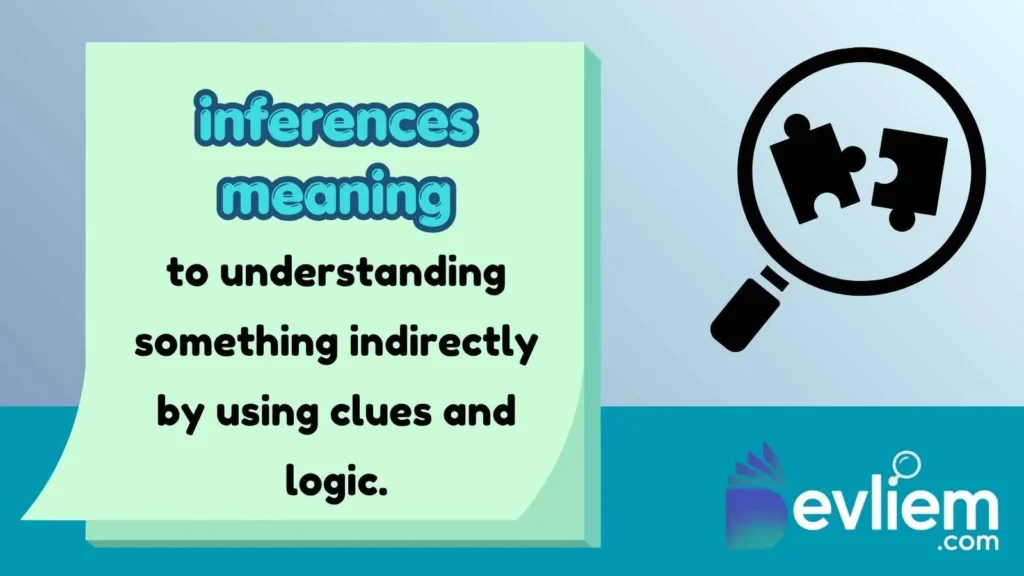
Quick Answer: Inferences meaning refers to understanding something indirectly by using clues and logic.
Singular vs Plural
- Inference = one conclusion
- Inferences = multiple conclusions
Word Origin
The word comes from Latin inferre, meaning “to bring in” or “deduce.” It later entered English as a logic and reasoning term.
How Meaning Evolved
Originally used in philosophy and formal reasoning, today it’s common in:
- School reading comprehension
- Psychology
- Detective stories
- Social media reactions
- Business communication
Pronunciation
Inference: IN-fer-uhns
Inferences: IN-fer-uhn-siz
How to Use “Inferences” Correctly in Texts & Chat
You usually use the word when discussing conclusions based on clues.
Correct Uses
- “The teacher asked us to make inferences from the story.”
- “My inferences were wrong because I lacked facts.”
- “She made several inferences from his tone.”
In Casual Conversations
- “Don’t make inferences without asking me.”
- “You jumped to conclusions based on weak inferences.”
In Professional Settings
Appropriate in workplaces, education, law, and research:
- “Our inferences are based on available data.”
- “We should avoid unsupported inferences.”
On Digital Platforms
Users on WhatsApp, Instagram, Discord, Reddit, and X often make inferences from:
- delayed replies
- typing indicators
- punctuation
- emoji use
- read receipts
When NOT to Use It
Avoid forcing the word into casual slang if “guess” works better.
Instead of: “My inference is pizza tonight.”
Better: “My guess is pizza tonight.”
Real Conversation Examples Using “Inferences”
1. Between Friends
Alex: He left early without saying bye.
Mia: My inference is he was upset.
Meaning: Mia uses behavior clues to conclude emotion.
2. Dating Scenario
Sam: She replies fast but never starts chats.
Jay: I’d make careful inferences there.
Meaning: Mixed signals require cautious interpretation.
3. Family Context
Mom: The cookies disappeared.
Dad: My inference is the kids were here.
Meaning: Evidence leads to a humorous conclusion.
4. Work Chat
Manager: Can we talk tomorrow morning?
Employee: I’m making scary inferences now.
Meaning: Unclear messages often trigger anxiety.
5. Gaming Chat
Player 1: He went silent after losing.
Player 2: My inference: rage quit.
Meaning: Behavior suggests frustration.
Common Mistakes & Misunderstandings
1. Confusing Inference with Observation
Observation: The lights are off.
Inference: Nobody is home.
One is seen directly. One is concluded.
2. Assuming Every Inference Is Correct
Nope. Inferences can be wrong if clues are weak.
Wet road? Maybe rain. Maybe sprinklers.
3. Mixing It Up with “Implication”
- Inference: What the listener concludes
- Implication: What the speaker suggests
That mix-up happens constantly.
Generational Misunderstandings
Older generations may prefer direct statements. Younger users often communicate through tone, emojis, and hints—creating more room for inferences.
How to Clarify
Use phrases like:
- “I may be wrong, but…”
- “That’s just my interpretation.”
- “Can you clarify what you meant?”
Smart communication beats wild guessing.
“Inferences” Across Different Platforms & Demographics
Gen Z
Often make rapid social inferences based on:
- reply speed
- lowercase texting
- emoji choices
- meme references
Millennials
Use inferences in workplace chats and relationships more than slang-heavy spaces.
Older Generations
May use the concept in reading, news, and practical reasoning rather than texting culture.
On Popular Platforms
TikTok
Users infer tone, sarcasm, trends, and hidden jokes quickly.
Stories, likes, follows, and captions create endless inferences.
Discord
Silence in group chats often sparks assumptions.
Safe for Work?
Yes. “Inference” is fully professional and formal.
Related Slang, Abbreviations & Alternatives
| Term | Meaning |
|---|---|
| Guess | Informal conclusion |
| Deduction | Logic-based conclusion |
| Assumption | Belief without enough proof |
| Interpretation | Personal understanding |
| Read between the lines | Find hidden meaning |
| Context clue | Hint from surrounding info |
| Implication | Suggested meaning |
| Insight | Deep understanding |
| Conclusion | Final judgment |
| Speculation | Uncertain theory |
Suggested internal anchors:
- Learn more about deduction meaning
- What does implication mean
- Context clues explained
- Reading comprehension tips
FAQs:
What is the simple meaning of inferences?
Inferences are conclusions made using evidence and reasoning instead of direct statements. You use clues to figure something out.
What is an example of an inference?
If someone enters dripping wet carrying an umbrella, you infer it’s raining outside.
Are inferences guesses?
Not exactly. Guesses may lack evidence. Inferences rely on clues, patterns, and logic.
Why do teachers teach inferences?
Because inference skills improve reading comprehension, critical thinking, and problem-solving.
Can inferences be wrong?
Absolutely. If evidence is incomplete or biased, the conclusion may fail.
What is the difference between infer and inference?
Infer is the verb.
Inference is the noun.
Example: “I infer he is tired.” / “My inference is he is tired.”
Conclusion:
Inferences meaning is simple once you strip away the textbook language: it means figuring something out from clues instead of being told directly.
You use inferences every day reading messages, understanding people, solving problems, and making decisions.
Mastering inferences makes you a sharper reader and communicator. Next time someone says little but means a lot, you’ll catch it.
Drop your favorite confusing phrase or hidden meaning text message in the comments below!

Hi, I’m Cross Read, the Writer and Creator behind devliem.com, where words stop being confusing and start making sense.
I’ve always been curious about language, how a single word can mean different things depending on context, culture, or even a trend. That curiosity turned into devliem, a space where I break down meanings, decode slang, and simplify the kind of terms people search every day.