Ever heard someone say Don’t be so defeatist, ” during an argument, game, or stressful group project?
The phrase pops up everywhere now from TikTok comment sections to workplace chats and even sports interviews.
Understanding the defeatist meaning matters because the word is often used to describe attitudes, energy, and even personality traits in modern communication.
A single we’re doomed anyway message in a group chat? People might instantly label it defeatist.
But here’s the thing: being realistic and being defeatist are not always the same. That’s where many people get confused.
In this updated 2026 guide, you’ll learn exactly what defeatist means, where the word came from, how people use it online today, common misunderstandings, and plenty of real conversation examples so you can recognize and use the term naturally.
What Does “Defeatist” Mean?
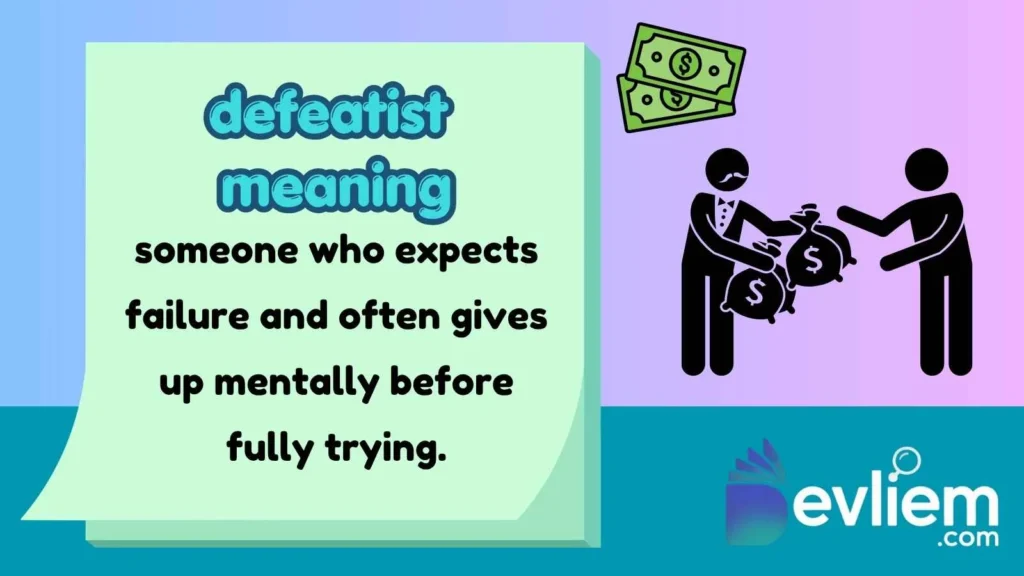
Quick Answer: A defeatist is someone who expects failure and often gives up mentally before fully trying.
The word defeatist comes from the noun “defeatism,” which became widely used during political and military discussions in the late 19th and early 20th centuries. Originally, it described people who believed losing a war was unavoidable.
Today, the meaning is broader and much more personal.
A defeatist person might:
- Assume things will fail immediately
- Lose motivation quickly
- Discourage others unintentionally
- Focus more on obstacles than solutions
Simple Definition
A defeatist is:
- overly negative about success,
- emotionally resigned to failure,
- or unwilling to try because they expect the worst outcome.
Pronunciation Guide
Defeatist is pronounced:
dih-FEE-tist
How the Meaning Has Evolved
Back then, “defeatist” was mostly political language. Now it’s common in:
- mental health conversations,
- gaming culture,
- sports commentary,
- productivity content,
- and social media debates.
People use it casually online all the time:
- “Bro stop being defeatist.”
- “That mindset is so defeatist.”
- “We haven’t even started yet!”
The term now often describes mindset rather than actual defeat.
How to Use “Defeatist” Correctly in Texts & Chat
Using “defeatist” correctly depends on tone and context.
It’s usually aimed at someone who sounds overly hopeless or negative.
Casual Usage
Common casual examples:
- “Why are you so defeatist about the exam?”
- “That’s a defeatist attitude.”
- “Stop talking like we already lost.”
The tone is usually:
- frustrated,
- motivational,
- teasing,
- or mildly critical.
Platform-Specific Usage
SMS & WhatsApp
Usually used during encouragement:
- “Don’t be defeatist. We can still fix this.”
Instagram & TikTok
Often appears in motivational or gym content:
- “Defeatist mindset will ruin your progress.”
Discord & Gaming Chats
Very common in competitive games:
- “Queue hasn’t even started and you’re already defeatist.”
Reddit & X
Used in debates and opinion threads:
- “That argument feels unnecessarily defeatist.”
When NOT to Use It
Avoid using “defeatist”:
- in formal business emails,
- during sensitive emotional situations,
- or when someone is dealing with real burnout or mental health struggles.
Calling someone defeatist can sound dismissive if they’re genuinely overwhelmed.
Formatting & Tone Tips
People usually write it:
- lowercase: “defeatist”
- without emojis in serious contexts
- sometimes paired with sarcastic emojis:
- 😭
- 💀
- 😩
Example:
- “Bro that’s so defeatist 💀”
Real Conversation Examples Using “Defeatist”
Between Friends
Alex: “There’s no way we pass this class.”
Jordan: “Dude, stop being so defeatist. The exam isn’t even here yet.”
Meaning: Jordan is calling out Alex’s hopeless attitude.
In a Gaming Chat
Player 1: “GG we already lost.”
Player 2: “Why are you being defeatist in round one?”
Meaning: The speaker thinks the negativity is premature.
Dating Scenario
Taylor: “They probably won’t text back anyway.”
Sam: “That’s a defeatist mindset. Give it time.”
Meaning: Sam encourages optimism instead of assuming rejection.
Family Conversation
Dad: “You’ll never learn driving if you quit after one mistake.”
Teen: “I’m trying!”
Dad: “Then don’t act defeatist.”
Meaning: The word is used to push perseverance.
Workplace Chat
Coworker: “This presentation is going to fail.”
Manager: “Let’s avoid defeatist thinking and focus on solutions.”
Meaning: Professional environments use the term more carefully and diplomatically.
Common Mistakes & Misunderstandings
1. Confusing Realism With Defeatism
This is the biggest misunderstanding.
Saying:
- “We need more preparation”
is realistic.
Saying:
- “There’s no point trying”
is defeatist.
The difference is whether the person still believes effort matters.
2. Using It as an Insult Too Quickly
Sometimes people label caution or stress as defeatism unfairly.
Someone can be:
- tired,
- anxious,
- or skeptical
without actually being defeatist.
That distinction matters.
3. Generational Misunderstandings
Gen Z often uses “defeatist” casually online.
Older generations may interpret it more seriously because historically the term had political and military associations.
A TikTok comment saying:
- “This mindset is defeatist af”
sounds normal to younger users but harsh to older readers.
Cultural Differences
In highly competitive cultures, defeatist attitudes are criticized strongly.
In other environments, cautious thinking may be viewed as wisdom rather than negativity.
Context changes everything.
“Defeatist” Across Different Platforms & Demographics
Gen Z Usage
Gen Z commonly uses “defeatist” in:
- meme culture,
- self-improvement content,
- gym motivation videos,
- gaming,
- and relationship discussions.
It’s often tied to “mindset culture.”
Example:
- “Defeatist mentality keeps people stuck.”
Millennials
Millennials tend to use the word more literally and psychologically.
You’ll often hear:
- “self-defeating behavior”
- “negative mindset”
- “learned helplessness”
instead of simply “defeatist.”
Older Generations
Older adults may associate the term with:
- politics,
- leadership,
- or morale during difficult situations.
The tone usually feels more serious to them.
TikTok & Instagram
Motivational creators use the term heavily:
- fitness videos,
- business advice,
- productivity clips,
- “discipline vs excuses” content.
Typical captions:
- “Your defeatist mindset is the real problem.”
Discord & Gaming Culture
Competitive communities use it constantly.
Players may call teammates defeatist when they:
- give up early,
- complain immediately,
- or mentally surrender before the match ends.
Is It Formal or Informal?
“Defeatist” sits in an interesting middle ground:
- acceptable in educated conversation,
- common online,
- but still emotionally charged.
It’s generally considered informal-to-neutral rather than highly formal.
Related Slang, Abbreviations & Alternatives
| Term | Meaning |
|---|---|
| Pessimistic | Always expecting bad outcomes |
| Cynical | Distrustful of motives or optimism |
| Doomposting | Posting exaggerated negativity online |
| Nihilistic | Believing life lacks meaning |
| Blackpilled | Internet slang for hopeless thinking |
| Debbie Downer | Someone who kills the mood with negativity |
| Self-defeating | Behaviors that hurt your own success |
| Hopeless | Feeling there is no chance of improvement |
| Negative mindset | General pattern of discouraging thoughts |
| Giving up mentality | Informal phrase for surrendering early |
Similar Terms
- pessimistic
- discouraged
- doubtful
- resigned
- unmotivated
Opposites
- optimistic
- determined
- resilient
- hopeful
- confident
FAQs:
What does defeatist mean in simple words?
A defeatist is someone who believes failure will happen before fully trying. The word usually describes a negative or hopeless attitude toward challenges, goals, or competition.
Is defeatist an insult?
It can be. Calling someone defeatist often criticizes their mindset or attitude. However, it can also be constructive if used gently in motivational conversations.
What is a defeatist mindset?
A defeatist mindset happens when someone assumes effort is pointless because they expect failure anyway. This thinking often lowers motivation and confidence.
Is defeatist the same as pessimistic?
Not exactly. A pessimistic person expects negative outcomes, while a defeatist person may mentally surrender or stop trying because they think success is impossible.
Can a positive person become defeatist?
Yes. Stress, repeated failure, burnout, or disappointment can temporarily create defeatist thinking, even in usually optimistic people.
Why do gamers use the word defeatist so much?
Competitive games involve teamwork and morale. Players often call others defeatist when they mentally give up too early and reduce team motivation.
Is defeatist a psychological term?
Not officially. Psychologists may discuss related concepts like learned helplessness, negative cognition, or self-defeating behavior instead.
Conclusion:
The defeatist meaning goes beyond simple negativity. It describes a mindset where someone expects failure so strongly that they stop believing effort matters.
Today, the term appears everywhere gaming chats, motivational TikToks, workplace conversations, and relationship advice. Sometimes it’s playful.
Sometimes it’s serious. Either way, understanding the nuance helps you recognize how modern communication works online and offline.
And honestly? Everyone sounds defeatist sometimes after a rough day. The key difference is whether the attitude becomes permanent.
Got a favorite internet slang term or chat abbreviation you want decoded next? Drop it in the comments and keep exploring the weird, fast-moving world of digital language.

Hi, I’m Emily Taylor, the voice behind Devliem.com, where meanings aren’t just explained, they’re made easy to understand.
I’ve always been fascinated by words, the way they change, evolve, and sometimes confuse us more than they should. That curiosity turned into a mission: to break down complex meanings, trending slang, and everyday expressions into something clear, simple, and actually useful.