Every now and then, a word pops up that sounds like it belongs in an old novel but still fits surprisingly well in today’s conversations. Balderdash is one of those words.
You might hear it in a heated debate, a witty comeback, or even a sarcastic comment online.
And the moment it drops, it usually shuts things down not because it’s complicated, but because it’s so sharply dismissive.
So what does it actually mean? And why do people still use it when we already have words like nonsense or rubbish
Let’s break it down in a way that feels natural, modern, and actually useful.
Meaning Overview of Balderdash
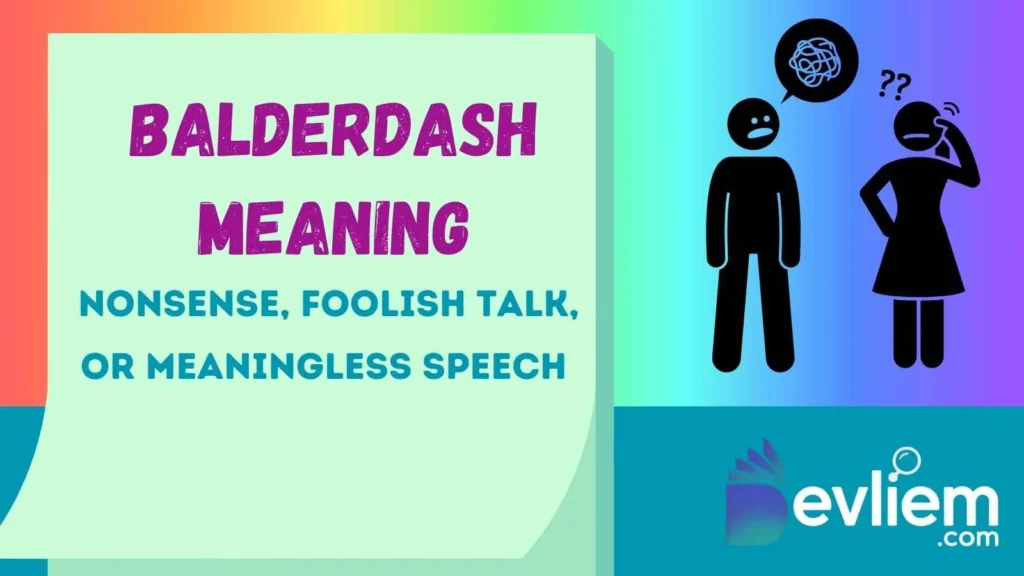
At its core, balderdash means nonsense, foolish talk, or meaningless speech.
It’s used when someone wants to dismiss what another person is saying as untrue, exaggerated, or simply not worth believing.
Simple meaning breakdown:
- Balderdash = nonsense
- Balderdash = ridiculous talk
- Balderdash = something not credible or sensible
But unlike casual words like “fake” or “trash,” balderdash carries a slightly dramatic, old-fashioned tone. It feels like something you’d say with raised eyebrows and a bit of attitude.
Full Form of Balderdash (Important Clarification)
Unlike abbreviations or slang acronyms, balderdash does NOT have a full form.
It is a complete word in itself, originating from older English vocabulary. So if you’re searching for a breakdown like “B.A.L.D.E.R.D.A.S.H,” there isn’t one—it’s not an acronym.
Instead, it belongs to a category of expressive English words that evolved over time for emotional emphasis rather than technical meaning.
Origin and History of Balderdash
The word balderdash dates back to the late 1500s to early 1600s, originally used in English to describe:
- a “confused mixture of liquids”
- or “senseless talk”
Over time, its meaning shifted from physical “mishmash” to verbal nonsense.
Linguists believe it may have been formed from playful sound combinations rather than strict Latin or Greek roots. That’s part of what makes it feel so expressive—it almost sounds like nonsense when you say it.
By the 18th and 19th centuries, writers used it more deliberately to mock exaggerated or foolish statements.
Even today, it survives mostly in:
- literature
- humor
- sarcastic speech
- dramatic arguments
Why “Balderdash” Still Feels Powerful Today
Even though it’s old, the word hasn’t disappeared. Why?
Because it carries something modern slang often lacks: dramatic dismissal with style.
Compare:
- “That’s nonsense.” (neutral)
- “That’s balderdash!” (strong, expressive, slightly theatrical)
It adds personality to disagreement. It doesn’t just reject an idea—it ridicules it in a refined way.
Quick Snapshot Table
| Word | Meaning | Tone | Usage Style |
|---|---|---|---|
| Balderdash | Nonsense or foolish talk | Dramatic, old-fashioned | Formal + sarcastic |
| Nonsense | Something not true or logical | Neutral | Everyday use |
| Garbage | Something worthless or false | Strong, informal | Casual/slang |
| Rubbish | Foolish or untrue statement | Mildly informal | British English common |
Early Usage Context (How It Appeared in Writing)
Historically, balderdash showed up in written English to:
- criticize exaggerated stories
- mock political claims
- dismiss absurd arguments in debates
Writers liked it because it sounded both intelligent and insulting at the same time—a rare combination.
A Modern Takeaway
Even today, when someone says “That’s balderdash,” they’re not just disagreeing. They’re adding personality, tone, and a bit of intellectual flair to their response.
It’s not a word you hear every day—but when you do, it usually stands out.
Now that we’ve covered where the word comes from and what it literally means, the real question is: how is “balderdash” actually used today?
The interesting part is that even though it’s an old-fashioned English word, it still shows up in modern digital conversations—just in very specific ways.
Let’s break that down naturally.
Meaning of Balderdash in Texting
In texting, balderdash is used to call something nonsense in a slightly dramatic or sarcastic way.
You won’t see it as often as “lol,” “cap,” or “fake,” but when it does appear, it usually carries a playful or exaggerated tone.
In simple texting meaning:
- “That’s balderdash” = “That’s nonsense / I don’t believe that”
- It often sounds humorous or sarcastic
- Sometimes used jokingly between friends
Example text messages:
- Friend 1: “I studied all night for 2 minutes.”
Friend 2: “Balderdash 😂 you were scrolling TikTok” - Friend 1: “I can finish this project in 10 minutes.”
Friend 2: “That’s pure balderdash.”
It’s less about confusion and more about calling out exaggeration in a witty way.
Balderdash on Snapchat
On Snapchat, language is usually short, fast, and informal. So balderdash isn’t commonly typed—but when it is, it’s used for:
- teasing friends
- reacting to obvious lies
- joking around in private chats
Snapchat users are more likely to use slang like:
- “cap”
- “no way”
- “bruh”
But balderdash adds a humorous “old-school vibe.”
Example:
- “You said you’re not online but I saw you on Snap maps… balderdash 😭”
It feels ironic and funny because it sounds like something your grandparents might say in a modern app.
Balderdash on TikTok
On TikTok, balderdash is rare but not invisible.
It usually appears in:
- sarcastic comment sections
- storytelling videos
- comedic skits pretending to be “old English speakers”
Creators sometimes use it for humor like:
- acting overly formal
- mocking dramatic reactions
- parodying “Victorian-style” speech
Example caption:
- “When someone says pineapple belongs on pizza… balderdash.”
On TikTok, its value is mostly comedic timing and personality, not everyday slang.
Balderdash on Instagram
On Instagram, the word might appear in:
- witty captions
- meme pages
- sarcastic story replies
It’s used to sound clever or dramatic rather than casual.
Example caption:
- “He said he’s ‘bad at texting’… balderdash.”
Instagram users sometimes like using older or fancy words for aesthetic or humor, and balderdash fits that pattern.
Real Conversation Examples (Natural Usage)
Let’s look at how it sounds in real life—not just online.
1: Friendly disagreement
- A: “This movie is the greatest film ever made.”
- B: “Balderdash. It was average at best.”
2: Sarcastic humor
- A: “I only ate one cookie.”
- B: “Balderdash… I saw the whole pack disappear.”
3: Light argument
- A: “I didn’t copy your homework.”
- B: “That’s balderdash and you know it.”
Notice how it doesn’t sound aggressive—it sounds dramatic but controlled.
How People Commonly Use “Balderdash”
Even though it’s not everyday slang, people who use it tend to do so for:
- dramatic emphasis
- humor or sarcasm
- intellectual-style insults
- playful disagreements
It’s not used in serious professional communication or formal writing anymore.
Tone and Emotional Meaning
The emotional tone of balderdash depends heavily on context.
It can feel like:
- sarcastic and playful
- theatrical or exaggerated
- mildly dismissive
- humorous in jokes
But it almost never feels truly aggressive. That’s why it survives in modern conversation—it’s insult-like without being harsh.
When You Should NOT Use “Balderdash”
Even though it’s fun, there are situations where it feels out of place:
- Formal emails or workplace communication
- Serious arguments where clarity matters
- Conversations with people unfamiliar with older English words
- Sensitive or emotional discussions
Using it in the wrong setting can make you sound:
- confusing
- overly dramatic
- unintentionally humorous
Quick Usage Insight Table
| Situation | Is “Balderdash” Suitable? | Why |
|---|---|---|
| Friendly joke | Yes | Adds humor |
| Online sarcasm | Yes | Sounds witty |
| Professional email | No | Too informal & old-fashioned |
| Serious argument | No | May sound dismissive instead of clear |
Similar Slang Terms to Balderdash
Even though balderdash is old-fashioned, modern English has plenty of words that carry a similar meaning.
Here are the closest equivalents:
Common alternatives:
- Nonsense – neutral and widely used
- Rubbish – more common in British English
- Garbage – informal and stronger tone
- BS (bullshit) – very informal and rude
- Cap – modern Gen Z slang for “lie”
- Fake – simple and direct dismissal
Quick comparison table:
| Term | Tone | Modern Usage | Strength |
|---|---|---|---|
| Balderdash | Dramatic, old-fashioned | Rare | Medium |
| Nonsense | Neutral | Very common | Medium |
| Cap | Modern slang | Very common online | Medium |
| BS | Rude / strong | Common informal | Strong |
| Rubbish | British informal | Common | Medium |
What makes balderdash unique is that it doesn’t feel harsh—it feels dramatic and slightly humorous, unlike stronger slang terms.
Key Differences Between Similar Terms
A common misunderstanding is thinking all these words are interchangeable. They aren’t.
- “Cap” is internet-native slang used mostly by younger users.
- “BS” is direct and can sound offensive.
- “Nonsense” is neutral and safe in almost any context.
- “Balderdash” adds personality and theatrical tone.
So if you want your reaction to sound:
- calm → “nonsense”
- modern → “cap”
- strong → “BS”
- expressive + witty → balderdash
Common Misunderstandings About Balderdash
People often misunderstand this word in a few ways:
1. Thinking it’s an insult
It’s not really an insult—it’s a dismissal of an idea, not a person.
2. Assuming it’s modern slang
It’s actually centuries old and predates internet slang entirely.
3. Believing it’s an acronym
It is NOT an abbreviation. It has no full form.
4. Thinking it’s outdated and useless
Even though it’s old, it still works in:
- humor
- sarcasm
- expressive speech
Cultural and Internet Context
In today’s internet culture, balderdash has found a small but interesting niche.
You’ll mostly see it:
- in meme humor
- in sarcastic comment sections
- in “Victorian-style” comedy posts
- in ironic storytelling
People often use it intentionally because it sounds overly formal compared to modern slang, which makes it funny.
It’s a bit like using “forsooth” or “prithee” in jokes—language becomes part of the humor itself.
What Does Balderdash Mean in Modern English?
At its simplest, balderdash means completely foolish or untrue talk. It is used when someone wants to reject a statement as ridiculous, exaggerated, or lacking logic.
But the interesting part is not just the definition — it’s the attitude behind it. The word carries a slightly dramatic, almost theatrical rejection, unlike plain words such as “wrong” or “false.”
It doesn’t just disagree — it dismisses with style.
Linguistic Breakdown of Balderdash (Word Analysis)
From a language perspective, balderdash is part of a rare group of expressive English words that are:
- sound-driven (phonetic emphasis)
- emotionally charged
- not derived from Latin/Greek roots
- built for expressive speech, not technical meaning
This makes it closer to words like:
- “hubbub”
- “gibberish”
- “mishmash”
It belongs more to expressive English storytelling vocabulary than academic language.
Historical Evolution of Balderdash Usage
Originally, in early English writing, the term was associated with:
- messy mixtures of liquids
- confused combinations
- meaningless chatter
Over centuries, the meaning shifted toward verbal nonsense instead of physical mixture.
What changed wasn’t the emotion — it was the target:
- Then → messy substance
- Now → messy speech or ideas
This evolution is common in English, where physical metaphors become linguistic judgments.
Psychological Tone Behind the Word
Balderdash is not emotionally neutral. It carries a very specific tone:
- mild disbelief
- intellectual dismissal
- slightly humorous superiority
- rhetorical exaggeration
People often use it when they want to sound:
- witty instead of aggressive
- expressive instead of rude
- dramatic instead of plain
That emotional layer is what keeps the word alive in modern usage.
Balderdash in Digital Communication (Internet Behavior Analysis)
Even though it is not trending slang, balderdash appears in niche internet behavior patterns:
Where it shows up online:
- sarcastic Reddit comments
- meme captions with “old English humor”
- parody Victorian-style content
- ironic storytelling posts
- humorous debates
It survives online not as mainstream slang, but as a stylistic choice for humor and tone control.
Balderdash in Text Messaging Culture
In texting, the word is used very intentionally because it feels unusual.
People don’t type it casually like “lol” or “cap.”
Instead, it appears when someone wants to:
- exaggerate disbelief
- make a joke sound dramatic
- respond humorously to obvious lies
Text examples:
- “You said you’re broke but ordered Uber Eats again… balderdash.”
- “That story is pure balderdash, I’m not buying it.”
It works best in friendly arguments or playful roasting.
Platform-Based Usage Differences
Snapchat Behavior
On Snapchat, communication is fast and visual. So balderdash appears:
- in jokes
- in reaction snaps
- in ironic replies
But it’s rare because users prefer short slang.
TikTok Context
On TikTok, it is used mainly for:
- comedic storytelling
- exaggerated “old-timey” speech
- satire content
It’s often used ironically rather than seriously.
Instagram Usage Style
On Instagram, it appears in:
- meme captions
- witty story replies
- sarcastic commentary
It’s used for aesthetic humor and personality expression.
When Balderdash Feels Natural vs Forced
Natural usage:
- joking with friends
- sarcastic responses
- playful disagreement
Forced usage:
- professional communication
- serious discussions
- unfamiliar audiences
The word works only when tone matches context.
Semantic Comparison With Modern Slang
| Expression | Era | Tone | Usage |
|---|---|---|---|
| Balderdash | Old English | Dramatic | Rare, expressive |
| Cap | Modern Gen Z | Casual | Very common |
| BS | Internet slang | Strong/rude | Informal |
| Nonsense | Standard English | Neutral | Universal |
| Gibberish | Neutral English | Descriptive | Formal-neutral |
This shows how balderdash sits in a stylistic, not functional, category of language.
Misuse Cases (Important for Clarity)
Many users misunderstand how to use it. Common mistakes include:
- using it as a modern slang replacement for “cap”
- using it in serious arguments where clarity matters
- assuming it is an acronym
- treating it as offensive slang
In reality, it is:
- expressive, not functional slang
- humorous, not insulting
- old-fashioned, not modern internet language
Cultural Value of the Word Today
Balderdash survives in modern culture for one main reason:
👉 It sounds entertaining, not just meaningful
People enjoy using it because it:
- adds personality to speech
- creates humor through contrast
- sounds “smartly dramatic”
- stands out in digital conversations
It is less about necessity and more about linguistic style choice.
How the Word “Balderdash” Functions in Real Communication
Balderdash is not just a definition-based word — it works more like a reaction tool in language.
When someone says it, they’re not simply labeling something as false. They are rejecting it with stylistic emphasis, often to add humor, sarcasm, or dramatic effect.
It behaves more like a language performance than a neutral vocabulary item.
Etymological Depth: How Sound Shaped the Meaning
Unlike many English words rooted in Latin or Greek, balderdash belongs to a category formed through phonetic construction.
That means:
- the sound influenced meaning
- not classical derivation
- emotional expression came first
Words in this category often feel:
- playful
- exaggerated
- informal in structure but expressive in tone
This is why balderdash feels “spoken” even when written.
Semantic Layering (Hidden Meaning Levels)
Balderdash operates on multiple meaning levels at once:
1. Literal level
Nonsense or foolish speech
2. Social level
A dismissal of credibility
3. Emotional level
Mild ridicule or disbelief
4. Stylistic level
A theatrical or humorous reaction
Most modern slang only carries 1–2 layers, but balderdash carries four simultaneous interpretations, which is why it stands out.
Pragmatic Usage in Conversation Flow
In real dialogue, balderdash usually appears as a reaction interrupt — meaning it breaks or challenges the flow of a statement.
It often replaces:
- “I don’t believe that”
- “That’s not true”
- “That’s exaggerated”
But it does so in a more expressive way, especially in spoken communication.
Emotional Intelligence Behind Using Balderdash
Using this word correctly depends heavily on emotional awareness.
It can signal:
- playful disbelief between friends
- intellectual disagreement in debate
- sarcastic humor in casual chat
But it can also accidentally sound:
- dismissive if tone is wrong
- overly dramatic in neutral situations
- confusing in younger digital audiences
So its effectiveness depends more on context sensitivity than vocabulary knowledge.
Balderdash in Modern Internet Linguistics
From a digital language perspective, balderdash belongs to a category called:
“archived expressive vocabulary used for aesthetic irony”
This means:
- it is not trending slang
- it is revived for humor
- it is used stylistically, not functionally
It appears in internet spaces where users intentionally mix:
- old language styles
- modern memes
- sarcastic tone shifts
Micro-Contexts Where Balderdash Appears Online
Instead of broad platforms, its usage appears in micro-scenarios like:
- comment threads under absurd claims
- parody historical roleplay accounts
- comedic “old English voice” posts
- exaggerated storytelling formats
- ironic debates about obvious jokes
This makes it a context-specific expressive word, not a general slang term.
Cognitive Effect of the Word on Readers
Interestingly, balderdash has a psychological impact due to its structure:
- it sounds unfamiliar
- it feels exaggerated
- it signals humor before meaning is processed
This creates a small delay in comprehension that often leads to:
- amusement
- curiosity
- attention retention
That’s why it works well in storytelling or comedic writing.
Register Shift: When Tone Changes Meaning
Balderdash changes meaning depending on register:
High register (formal tone)
Sounds like intellectual dismissal
Mid register (neutral speech)
Sounds humorous or theatrical
Low register (casual slang environment)
Sounds ironic or outdated joke language
This flexibility is why it survives in modern communication.
Communication Breakdown Risk
There is a risk when using balderdash in fast digital environments:
- some users may not understand it instantly
- it may interrupt conversational flow
- it can feel “overwritten” in casual texting
So in modern slang-heavy platforms, clarity sometimes drops.
Cross-Generational Perception of Balderdash
Different age groups interpret it differently:
- Older users → recognize it as formal English dismissal
- Middle users → see it as humorous or theatrical
- Younger users → perceive it as ironic or meme-like word
This makes it a multi-generational interpretive term, which is rare in modern slang.
Semantic Replacement in Modern Speech
Instead of balderdash, modern users often default to:
- “that’s cap”
- “no way”
- “that’s fake”
- “lol no”
But each replacement removes something balderdash retains:
👉 dramatic tone + linguistic flair
Linguistic Rarity Factor
Balderdash belongs to a shrinking category of English words that:
- are still understood
- are rarely used
- carry strong stylistic identity
This makes it valuable in writing because it creates:
- voice differentiation
- tonal uniqueness
- rhetorical impact
FAQs:
What does balderdash mean in simple words?
Balderdash means nonsense or foolish talk that is not true or believable.
Is balderdash a bad word?
No, it is not a curse word. It’s mild and often used in a humorous or dramatic way.
Is balderdash used in modern English?
Yes, but rarely. It appears mostly in jokes, literature, or sarcastic speech.
What is balderdash in texting?
In texting, it means “I don’t believe that” or “that’s nonsense,” often used playfully.
Is balderdash similar to cap?
Yes, both can mean “lie” or “nonsense,” but “cap” is modern slang while “balderdash” is old-fashioned.
Can I use balderdash in formal writing?
It’s generally not recommended unless you’re writing creatively or stylistically.
Final Thoughts:
Balderdash is one of those rare words that refuses to disappear completely.
It doesn’t compete with modern slang, and it doesn’t need to. Instead, it survives because it adds something most short internet words don’t character.
When someone says it, they’re not just rejecting an idea. They’re doing it with flair, humor, and a hint of theatrical frustration.
And maybe that’s why it still works today:
in a world full of fast slang like cap and fake balderdash slows things down just enough to make a point sound memorable.

Hi, I’m Emily Taylor, the voice behind Devliem.com, where meanings aren’t just explained, they’re made easy to understand.
I’ve always been fascinated by words, the way they change, evolve, and sometimes confuse us more than they should. That curiosity turned into a mission: to break down complex meanings, trending slang, and everyday expressions into something clear, simple, and actually useful.