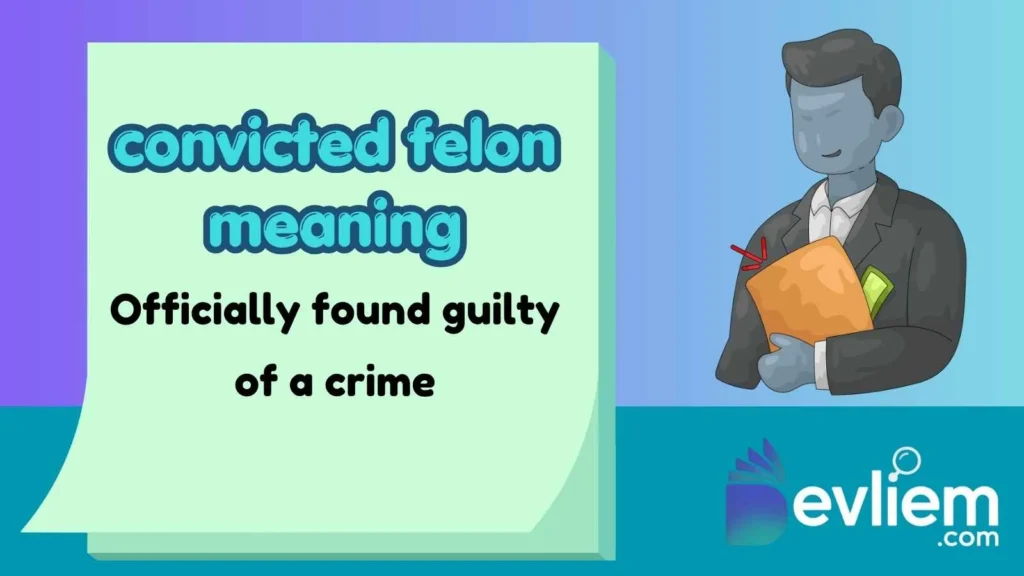
A convicted felon is a person who has been found guilty of a felony offense by a court of law.
Understanding the meaning of a convicted felon can help clarify how criminal convictions affect an individual’s rights, employment opportunities, voting eligibility, and social standing.
In this guide, we’ll explain the definition of a convicted felon, how someone receives this designation, common examples of felony crimes, and the lasting impact a felony conviction can have on a person’s life.
What Does “Convicted Felon” Mean?
The term convicted felon refers to a person who has been found guilty of committing a felony crime through a court of law. In simple terms, it describes someone who was charged with a serious criminal offense and was officially convicted by a judge or jury.
Quick Definition
| Term | Meaning |
|---|---|
| Convicted | Officially found guilty of a crime |
| Felon | A person who committed a felony |
| Convicted Felon | Someone legally found guilty of a felony offense |
Many people hear this phrase in news reports, political discussions, court cases, crime documentaries, and social media debates.
Is “Convicted Felon” an Acronym or Full Form?
No.
It is a legal phrase made up of two separate words:
- Convicted = declared guilty in court
- Felon = a person guilty of a felony
Together, they create a specific legal label used in criminal justice systems.
Understanding the Legal Meaning
To fully understand the phrase, it’s important to know what a felony is.
Common Crime Categories
| Category | Typical Severity |
|---|---|
| Infraction | Minor violations |
| Misdemeanor | Less serious crimes |
| Felony | Serious criminal offenses |
These penalties can include:
- Long prison sentences
- Large fines
- Probation
- Loss of certain civil rights
Examples of felony offenses may include:
- Armed robbery
- Murder
- Major fraud schemes
- Kidnapping
- Certain drug trafficking crimes
Origin and History of the Term
The word felony has deep historical roots.
Over time, courts used the term to classify serious crimes that carried severe punishments.
The phrase convicted felon became common in legal documents, court records, newspapers, and public discussions to distinguish individuals who had received a felony conviction from those merely accused of crimes.
This distinction remains important today.
Why the Phrase Matters
Many people mistakenly use the terms suspect, criminal, and convicted felon interchangeably.
Legally, they are very different.
| Term | Meaning |
|---|---|
| Suspect | Someone believed to have committed a crime |
| Defendant | Person facing criminal charges |
| Convicted Felon | Person legally found guilty of a felony |
| Inmate | Person currently serving time in custody |
How People Commonly Use “Convicted Felon”
Outside legal documents, the phrase appears in everyday conversations, media coverage, and online discussions.
Examples include:
- News reporting
- Political commentary
- Crime documentaries
- Court discussions
- Public records searches
- Employment background checks
Example Sentences
- “The convicted felon was sentenced to ten years in prison.”
- “The company refused to hire applicants without reviewing the circumstances behind the felony conviction.”
- “The documentary followed the life of a convicted felon after release from prison.”
- “The news article repeatedly referred to him as a convicted felon.”
In these examples, the phrase identifies someone whose guilt has already been legally established.
Does “Convicted Felon” Have a Meaning in Texting?
Not usually.
Texting Example
Did you really eat my leftovers again?”
Maybe.”
Meaning on Social Media Platforms
TikTok
- Crime stories
- Court cases
- Celebrity controversies
- Political news
- Viral legal discussions
- Criminal justice topics
- True crime content
- News updates
- Public figures
X (Twitter)
- Election cycles
- Breaking legal news
- Public scandals
- Court rulings
Users often debate the legal, ethical, or political implications surrounding felony convictions.
The Emotional Tone Behind the Phrase
The phrase carries a strong emotional weight.
Depending on context, it may sound:
- Serious
- Formal
- Judgmental
- Informative
- Stigmatizing
- Neutral
A courtroom transcript uses the term neutrally.
A social media argument may use it as criticism or an insult.
Understanding the speaker’s intent helps determine how the phrase is being used.
Common Misunderstandings About Convicted Felons
Several myths surround the term.
Myth 1: Anyone Arrested Is a Convicted Felon
False.
An arrest does not equal a conviction.
Myth 2: All Convicted Felons Go to Prison
Not necessarily.
Some receive probation, community supervision, fines, or alternative sentences.
Myth 3: A Conviction Never Stops Affecting Someone
The reality is more complicated.
The impact depends on:
- Local laws
- Type of offense
- Time elapsed
- Rehabilitation programs
- Expungement options
Myth 4: Every Felony Is Violent
False.
Many felony offenses involve financial crimes, fraud, or nonviolent offenses.
Situations Where You Should Not Use the Term
- No conviction exists
- Information hasn’t been verified
Real Conversation Examples
Example 1: News Discussion
Person A: “Why is everyone talking about the court case?”
Example 2: Legal Context
Attorney: “The conviction remains part of the public record.”
Example 3: Humorous Use
You stole my fries.”
It was one fry.”
Sounds like convicted felon behavior.”
Similar Terms People Search For
Users looking up convicted felon meaning often search for related legal terms.
These can serve as useful internal linking opportunities:
- Felony meaning
- Misdemeanor meaning
- Defendant meaning
- Criminal record meaning
- Probation meaning
- Indictment meaning
- Acquitted meaning
- Parole meaning
- convictions meaning
- Arrested vs convicted
Convicted Felon vs Ex-Felon
| Term | Meaning |
|---|---|
| Convicted Felon | Person found guilty of a felony |
| Ex-Felon | Person with a past felony conviction, often after completing punishment |
Cultural and Media Influence
True crime podcasts, documentaries, streaming series, and social media discussions have increased public familiarity with legal terminology.
- convicted felon
- indictment
- plea deal
- acquittal
Why the Label “Convicted Felon” Often Appears in News Headlines
If you’ve ever watched a major court case unfold in the media, you’ve probably noticed journalists using the phrase “convicted felon” repeatedly. News organizations use this term because it conveys a specific legal status rather than a personal opinion.
Reporters are expected to distinguish between someone who has been accused of a crime and someone who has been legally convicted. Calling a person a convicted felon signals that a court has already reached a guilty verdict or accepted a guilty plea for a felony offense.
The phrase also helps readers quickly understand the seriousness of the underlying crime without needing to read an entire legal explanation.
How a Person Becomes a Convicted Felon
Many people know what the term means but aren’t sure how someone actually receives that designation.
A typical criminal case may involve several stages:
- Investigation by law enforcement
- Arrest or criminal charges
- Court proceedings
- Trial or plea agreement
- Conviction
- Sentencing
A person is not considered a convicted felon during the investigation or accusation stage. The status only applies after a legal conviction for a felony offense has been entered by the court.
This distinction is one reason legal professionals are careful about the language they use when discussing ongoing cases.
Why the Term Can Be Controversial
Although “convicted felon” is legally accurate, some people believe the label can follow an individual long after they have completed their sentence.
Critics argue that constantly identifying someone by their past conviction may make it harder for them to:
- Find employment
- Secure housing
- Build professional relationships
- Reintegrate into society
Others believe the public has a right to know about serious criminal convictions, especially when they involve public trust, government positions, or community safety.
Because of these differing viewpoints, the phrase often appears in broader discussions about criminal justice reform and rehabilitation.
The Difference Between Public Opinion and Legal Reality
One of the biggest misunderstandings surrounding criminal cases is the gap between public opinion and legal findings.
A person may be viewed negatively online, criticized by the media, or accused by thousands of social media users. However, none of those factors automatically make them a convicted felon.
Legal systems rely on evidence, due process, and court decisions rather than public sentiment.
This distinction becomes especially important during high-profile cases where online discussions can spread faster than verified legal information.
How the Meaning Changes Depending on Context
The phrase doesn’t always carry the same message.
courtroom, it functions as a factual legal description.
journalism, it provides context for a story.
political discussions, it may become part of a larger debate.
social media conversations, people sometimes use it to express criticism, frustration, or even sarcasm.
Because context changes interpretation, readers should pay attention to how and where the phrase is being used.
Common Questions People Have After Hearing the Term
When someone first encounters the phrase “convicted felon,” they often wonder:
- What crime was committed?
- Was the conviction recent or decades old?
- Did the person serve a prison sentence?
- Is the conviction still active?
- Are there appeals involved?
The phrase itself does not answer these questions. It simply confirms that a felony conviction occurred.
Additional details usually require examining court records, legal documents, or reliable news reports.
Why Accuracy Matters When Discussing Criminal Records
Misusing legal terms can unintentionally spread misinformation.
For example, saying someone is a convicted felon without proof can damage reputations and create confusion. That’s why responsible journalists, attorneys, and researchers verify legal records before using the term.
When discussing criminal cases online, it’s helpful to distinguish between:
- Allegations
- Charges
- Arrests
- Trials
- Convictions
Each stage represents a different point in the legal process.
How Movies and Television Shape Public Understanding
Crime dramas and courtroom shows have introduced legal terminology to millions of viewers. As a result, many people recognize phrases like:
- Convicted felon
- Plea bargain
- Jury verdict
- Criminal defendant
- Reasonable doubt
However, television often simplifies legal procedures for entertainment purposes.
Real-world criminal cases are frequently more complex than what viewers see in a one-hour episode. Understanding the actual legal meaning of these terms helps separate fiction from reality.
Search Terms Related to Convicted Felon Meaning
Users researching this topic often look for related questions such as:
- What qualifies as a felony?
- What happens after a felony conviction?
- Difference between felony and misdemeanor
- Can a felony conviction be removed?
- What rights do convicted felons lose?
- What is an ex-felon?
- How long does a felony stay on your record?
Covering these related topics helps provide a more complete understanding of the phrase and its real-world implications.
Why Understanding Legal Terminology Is Important
Legal phrases often appear intimidating because they are used in formal settings. Yet understanding them can make news reports, court cases, and public discussions much easier to follow.
The term “convicted felon” is a good example. While it may sound complex, it simply identifies a person who has been legally found guilty of a felony offense.
Knowing the precise meaning helps people interpret information accurately, avoid common misconceptions, and engage in more informed discussions about crime, justice, and the legal system.
Can Someone Be a Convicted Felon Without Going to Trial?
Many people assume that every felony conviction comes after a dramatic courtroom trial. In reality, a large number of felony cases never reach that stage.
A person can become a convicted felon by entering a guilty plea as part of a plea agreement. In this situation, the defendant admits guilt, and the court records the conviction without a full trial.
This is one reason legal experts often emphasize that a conviction does not always mean a jury delivered a guilty verdict. The outcome can result from different legal processes, but the conviction itself carries the same legal significance.
How Employers May View a Felony Conviction
Employment is one of the areas where a felony conviction can have long-term effects. Some employers conduct background checks and may consider criminal history when evaluating applicants.
However, policies vary widely between industries, companies, and jurisdictions.
Factors that employers may consider include:
- The nature of the offense
- How much time has passed
- Evidence of rehabilitation
- Job-related responsibilities
- Local employment laws
Many organizations now focus on evaluating applicants individually rather than making automatic decisions based solely on a criminal record.
The Role of Background Checks
Background checks have become common in hiring, housing applications, professional licensing, and volunteer positions.
When a felony conviction appears during a screening process, decision-makers often review additional details rather than relying only on the label “convicted felon.”
For example, they may examine:
- The date of conviction
- The severity of the offense
- Whether the offense relates to the position
- The applicant’s conduct since the conviction
Because screening policies differ, the impact of a felony record can vary significantly from one situation to another.
How Different Countries Define Serious Crimes
The term “convicted felon” is most commonly associated with the United States legal system. Other countries may classify serious offenses differently.
Some legal systems use alternative categories and terminology instead of dividing crimes into felonies and misdemeanors.
As a result, the phrase may not always have a direct equivalent in every country. Understanding the local legal framework is important when discussing criminal convictions internationally.
Why Court Records Matter
When researching a criminal case, court records are often the most reliable source of information.
Media reports may summarize events, but court documents provide details about:
- Charges filed
- Legal proceedings
- Convictions
- Sentences
- Appeals
Because legal terminology can be misunderstood, reviewing official records helps ensure that statements about a person’s status are accurate.
The Difference Between a Conviction and a Sentence
People sometimes confuse a conviction with a sentence, but they are separate legal concepts.
A conviction answers the question:
“Was the person found guilty?”
A sentence answers the question:
“What punishment was imposed?”
For example, two individuals may both be convicted of felony offenses but receive very different sentences depending on the circumstances of their cases.
This distinction is essential for understanding criminal justice terminology.
How Public Figures Are Affected by Felony Convictions
When celebrities, business leaders, athletes, or politicians face felony convictions, public attention often intensifies.
In these situations, the phrase “convicted felon” frequently becomes part of news coverage because journalists use it to describe the person’s legal status.
Public figures may experience additional consequences such as:
- Reputational damage
- Loss of endorsements
- Increased media scrutiny
- Public criticism
- Professional challenges
The level of impact often depends on the nature of the offense and the individual’s public role.
Why Legal Language Can Sound Harsh
Legal terminology is designed to be precise rather than emotionally sensitive.
Words such as:
- Defendant
- Offender
- Conviction
- Felon
serve specific legal purposes. However, outside legal settings, these terms can sometimes feel harsh or stigmatizing.
This difference between legal precision and everyday language explains why discussions about criminal justice often include debates about labeling and rehabilitation.
How Search Engines and Online Databases Use the Term
Many online databases, news archives, and public record systems use standardized legal terminology to organize information.
The phrase “convicted felon” may appear in:
- Court record databases
- Criminal history reports
- News archives
- Legal research platforms
- Government publications
Because the term has a specific legal meaning, it helps ensure consistency when records are categorized and searched.
What People Usually Mean When They Search “Convicted Felon Meaning”
Most users searching this phrase are looking for more than a dictionary definition.
They often want to understand:
- Whether the person was found guilty
- How serious the crime was
- What legal consequences may follow
- How the term differs from being arrested
- Why the phrase appears in headlines
Understanding this broader search intent helps explain why the term attracts significant attention during major legal cases and public controversies.
How Language Around Criminal Records Has Evolved
Over time, discussions about criminal justice have influenced the way people talk about convictions and criminal records.
Some organizations now encourage the use of person-first language, such as:
- “A person with a felony conviction”
- “An individual with a criminal record”
instead of defining someone entirely by a past offense.
Supporters of this approach argue that language can influence public perceptions and opportunities for rehabilitation. While legal documents still use traditional terminology, public conversations continue to evolve.
Key Facts to Remember About a Convicted Felon
Before using the phrase, keep these important points in mind:
It refers to someone legally found guilty of a felony offense.
An arrest alone does not create a felony conviction.
The term has a formal legal meaning.
It is commonly used in news reporting and court discussions.
Context matters when interpreting how the phrase is being used.
Not all felony convictions involve violent crimes.
Understanding these facts helps prevent confusion and promotes more accurate discussions about legal issues and criminal records.
FAQs:
What does convicted felon mean in simple words?
A convicted felon is a person who has been officially found guilty of committing a felony crime by a court.
Does being arrested make someone a convicted felon?
A conviction requires a legal finding of guilt.
Is convicted felon a slang term?
No. It is a formal legal term, although people sometimes use it jokingly online.
Can a convicted felon vote?
Voting rights depend on the laws of the country, state, or jurisdiction involved.
Are all convicted felons violent criminals?
No. Many felony convictions involve nonviolent offenses such as fraud, financial crimes, or certain drug-related offenses.
Can someone stop being called a convicted felon?
Rules vary by jurisdiction.
Final Thoughts:
The phrase convicted felon has a precise legal meaning: a person who has been formally found guilty of a felony offense in court.
The term applies only after a lawful conviction has occurred.
Understanding that difference helps prevent confusion and encourages more accurate conversations about criminal justice, public records, and legal proceedings.

Hi, I’m Emily Taylor, the voice behind Devliem.com, where meanings aren’t just explained, they’re made easy to understand.
I’ve always been fascinated by words, the way they change, evolve, and sometimes confuse us more than they should. That curiosity turned into a mission: to break down complex meanings, trending slang, and everyday expressions into something clear, simple, and actually useful.