Understanding the meaning of fascism isn’t as simple as looking up a dictionary definition.
It’s one of those words that carries enormous historical weight, yet it also appears in everyday conversations, political debates, news headlines, and even social media comments.
Some use it accurately to describe a political ideology, while others use it as a casual insult without understanding its historical significance.
What Does Fascism Mean?
In simple terms, fascism promotes the idea that the nation or state should come before individual rights.
Fascist governments often concentrate power in a single leader or ruling party, discourage dissent, and use propaganda to strengthen their authority.
Quick Definition
| Term | Meaning |
|---|---|
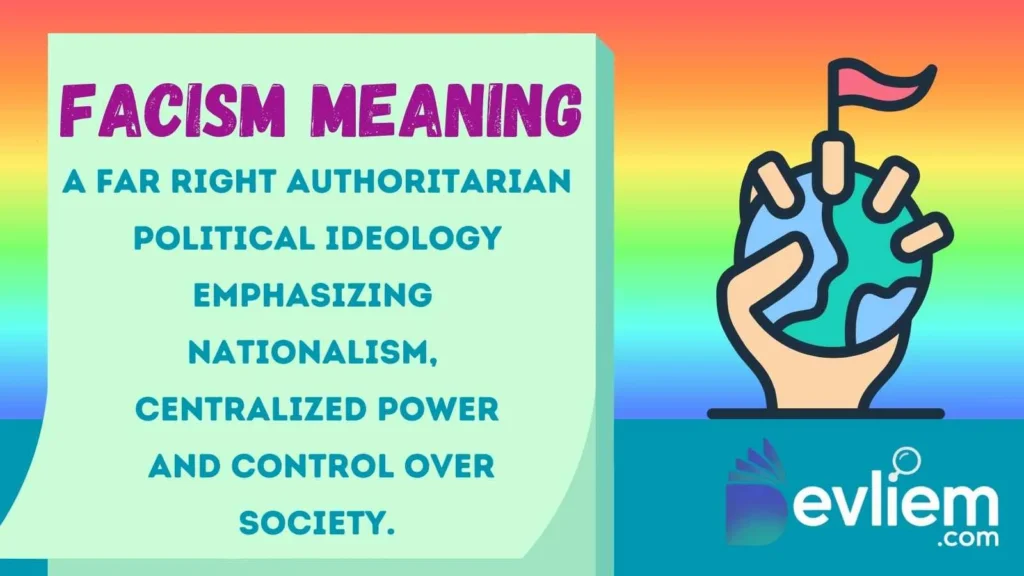
| Fascism | A far-right authoritarian political ideology emphasizing nationalism, centralized power, and control over society. |
| Word Type | Noun |
| Pronunciation | FASH-iz-um |
| Common Contexts | Politics, history, news, education, online discussions |
Is “Facism” Correct?
Many people search for “facism meaning,” but the correct spelling is fascism.
Incorrect: Facism
Correct: Fascism
The missing “s” is a common typing mistake because the word’s pronunciation can make it sound like “facism.”
Does Fascism Have a Full Form?
No.
Fascism is not an acronym, so it does not have a full form.
Instead, the word comes from the Italian word “fascio,” meaning a bundle or group. Historically, it referred to strength through unity.
Origin and History of Fascism
The word fascism originated in Italy during the early 20th century.
It became associated with Benito Mussolini, who established the world’s first fascist government in 1922.
The symbol represented authority, power, and unity under a single government.
During the 1930s and 1940s, fascism spread to other countries and became closely linked with aggressive nationalism, militarism, censorship, and political repression. It played a major role in the events leading to World War II.
Because of this history, the word carries serious historical and emotional significance today.
What Are the Main Characteristics of Fascism?
Although historians sometimes debate the exact definition, fascist governments usually share several core features:
- Strong authoritarian leadership
- Extreme nationalism
- Suppression of political opposition
- Strict government control
- Heavy use of propaganda
- Limited civil liberties
- Military strength emphasized
- Loyalty to the state above individual rights
Not every authoritarian government is fascist, but these characteristics often appear together in fascist movements.
Fascism Meaning in Texting
In everyday texting, fascism rarely refers to the full political ideology.
Instead, people often use the word to criticize someone they believe is being overly controlling or authoritarian.
Example
Person A: “Our school banned all student clubs.”
Person B: “That feels like fascism.”
Here, the speaker is expressing frustration rather than making a precise political analysis.
Because the word has a very specific historical meaning, using it casually can sometimes create confusion.
Fascism Meaning on Snapchat
On Snapchat, the word usually appears in conversations about:
- Politics
- News events
- Government policies
- Trending social issues
- Memes discussing authority
It generally keeps its standard political meaning rather than developing unique Snapchat slang.
Fascism Meaning on TikTok
TikTok creators often use fascism when discussing:
- History
- Political education
- Current events
- Government comparisons
- Documentary-style videos
Whenever you encounter political claims on TikTok, it’s wise to verify information using reliable historical sources.
Fascism Meaning on Instagram
On Instagram, the term commonly appears in:
- News graphics
- Political commentary
- Educational history pages
- Opinion posts
- Infographics
Some creators explain the historical definition, while others use the term rhetorically during debates.
How People Commonly Use the Word
People generally use fascism in three ways.
1. Historical Discussion
Example:
“We studied fascism during our World War II history class.”
2. Political Analysis
Example:
“The article examined whether certain political movements share characteristics associated with fascism.”
3. Hyperbolic Everyday Speech
Example:
“My manager checks every email before it’s sent—that’s practically fascism.”
Real Conversation Examples
Example 1
Alex: Did you watch the history documentary?
Jordan: Yes, it explained how fascism developed in Europe.
Example 2
Emma: People online keep calling everything fascism.
Ryan: Sometimes the word is used too broadly.
Example 3
Chris: Our debate focused on authoritarian governments.
Taylor: Fascism was one of the ideologies we discussed.
Tone and Emotional Meaning
Unlike many internet slang terms, fascism carries a serious tone.
Depending on context, it may express:
- Criticism
- Concern
- Political disagreement
- Historical discussion
- Moral condemnation
Because of its association with dictatorship, oppression, and World War II, the word often evokes strong emotions.
When You Should NOT Use the Word
Using fascism casually can weaken its meaning or create misunderstandings.
Avoid using it when:
- Someone simply disagrees with you.
- A teacher enforces classroom rules.
- Parents set reasonable household boundaries.
- A company has an unpopular policy.
- A friend makes a minor decision you dislike.
Not every strict rule or unpopular decision qualifies as fascism.
Choosing more accurate words—such as strict, authoritarian, controlling, or overbearing—may better describe the situation.
Common Misunderstandings
Several misconceptions appear frequently online.
Myth 1: Fascism Means Any Dictatorship
Not exactly.
While fascist governments are authoritarian, not every dictatorship is fascist.
Myth 2: Fascism Is Just Another Word for “Strict”
No.
Strict rules alone do not define fascism.
Myth 3: It’s Only an Internet Insult
Although people sometimes use it as an insult, fascism is a real political ideology with a documented historical background.
Fascism vs Similar Political Terms
| Term | Meaning | Main Difference |
|---|---|---|
| Fascism | Authoritarian nationalist ideology | Emphasizes nationalism and centralized power |
| Authoritarianism | Government limiting freedoms | Broader category than fascism |
| Totalitarianism | Government controls nearly every aspect of life | Can exist under different ideologies |
| Dictatorship | Rule by one leader | Not necessarily fascist |
| Nationalism | Pride in one’s nation | Doesn’t automatically equal fascism |
Understanding these differences helps avoid oversimplifying complex political concepts.
Cultural and Internet Context
On today’s internet, political language often spreads quickly through memes, viral posts, and short videos.
As a result, words like fascism, socialism, communism, and authoritarianism are sometimes used loosely.
While memes can make political ideas more accessible, they can also blur important distinctions. Looking beyond headlines or viral posts helps build a more accurate understanding of these terms.
Similar Terms You May Want to Learn
If you’re interested in political vocabulary, these related terms are worth exploring:
- Authoritarianism
- Totalitarianism
- Democracy
- Communism
- Socialism
- Capitalism
- Nationalism
- Populism
- Liberalism
- Conservatism
These topics make useful internal links for readers who want a broader understanding of political language.
A Quick Reality Check: Why “Fascism” Is Often Misunderstood
The word fascism gets thrown around a lot online, often in arguments, memes, and political debates. But here’s the issue — most people using it casually don’t fully understand what it actually represents in political history.
In real academic and historical context, fascism is not just a label for “strict rules” or “authority.” It refers to a very specific system of power that emerged in 20th-century Europe and had global consequences.
That gap between historical meaning vs. internet usage is where confusion starts.
Core Fascism Meaning (Simple Explanation)
Fascism is a political ideology where:
- The state holds absolute authority
- Individual freedoms are heavily restricted
- Opposition is suppressed
- National identity is pushed aggressively
- A single leader or ruling group dominates power
In simple language, fascism puts the government above the people, often with strict control over society.
Linguistic Meaning and Word Formation
The word fascism comes from the Italian word “fascio”, meaning a bundle or group tied together.
Symbolically, it represented:
- Strength through unity
- Power through collective identity
- Loyalty to a central authority
This origin is important because it explains why fascist ideology often focuses on unity under one leader or system.
Historical Background: How Fascism Emerged
Fascism first developed in early 20th-century Italy, led by Benito Mussolini.
It grew after:
- Economic instability in Europe
- Post–World War I political chaos
- Public distrust in democratic systems
Mussolini’s government introduced:
- Strict censorship
- Military expansion
- Political intimidation
- Propaganda systems
Later, similar ideologies appeared in other countries, most famously in Nazi Germany (though Nazism is a distinct ideology with overlapping elements).
Political Structure of Fascist Systems
Fascist governments typically include:
Centralized Power
Decision-making is concentrated in one leader or ruling party.
Controlled Opposition
Political opponents are often silenced or removed.
National Supremacy Ideology
The nation is presented as superior and must be protected at all costs.
State-Controlled Messaging
Media and education may be used to shape public opinion.
Fascism in Modern Conversations
Today, fascism is rarely used in a strict academic sense in casual conversation. Instead, it appears in:
- Political debates
- Social media arguments
- News comment sections
- Meme culture
However, modern usage often stretches the meaning beyond its historical definition.
Example:
“They changed the app rules again, this is fascism.”
This is emotional exaggeration, not a literal political classification.
Fascism Meaning in Text Messages
In texting, people usually use the word to express frustration with control or authority.
Example Conversations
A: “The teacher made us redo the assignment three times.”
B: “That’s brutal… feels like fascism lol.”
Here, the word is used loosely to express annoyance, not political analysis.
Fascism on Social Media Platforms
TikTok Context
On TikTok, fascism often appears in:
- Educational history clips
- Political commentary videos
- Satirical content
- Reaction debates
Tone can vary from serious explanation to ironic humor.
Instagram Context
On Instagram, usage is usually:
- Infographics about history
- Political opinion posts
- Awareness pages
- Comment section debates
It is more structured compared to TikTok’s casual tone.
Snapchat Context
On Snapchat, usage is minimal but appears in:
- Private political conversations
- Reaction to news events
- Casual debates between friends
When the Word “Fascism” Is Used Correctly
Proper usage includes:
- Historical analysis
- Academic discussion
- Political science context
- Documentaries or research
Example:
“Fascism played a major role in shaping Europe before World War II.”
When It Is Misused (Very Common Online)
Misuse happens when people apply it to:
- Strict parents
- School rules
- Workplace policies
- Minor disagreements
- Basic authority decisions
These situations are not fascism, even if they feel frustrating.
Emotional Weight Behind the Term
Fascism is not a neutral word. It carries:
- Historical trauma
- Associations with war
- Memory of dictatorship
- Fear of oppression
That’s why using it casually can feel intense or inaccurate depending on context.
Fascism vs Other Political Concepts
| Term | Core Idea | Key Difference |
|---|---|---|
| Fascism | Extreme authoritarian nationalism | Centralized power + ideology |
| Authoritarianism | Strict government control | Broader, not always nationalist |
| Totalitarianism | Total state control of life | More extreme control scope |
| Dictatorship | Rule by one leader | May lack ideology |
| Democracy | People’s rule | Opposite structure |
Common Misinterpretations Explained
“Anything strict is fascism”
Not true. Strictness alone doesn’t define political ideology.
“It’s just a modern insult”
Incorrect. It is a real historical system of governance.
“It only existed in the past”
While historical fascism peaked in the 1900s, its study remains relevant in political science today.
Why People Overuse the Term Online
There are a few reasons:
- Emotional reactions in arguments
- Lack of historical understanding
- Meme culture exaggeration
- Influence of short-form content
- Simplifying complex politics into one word
This leads to the term losing precision in casual spaces.
Better Words to Use Instead of “Fascism”
If you just mean someone is controlling or strict, better options include:
- Overcontrolling
- Authoritarian behavior
- Strict rules
- Unfair system
- Heavy-handed approach
These terms communicate meaning without historical distortion.
Real-World Examples for Clarity
Historical Example
Fascist governments in 20th-century Europe used propaganda and strict political control.
Modern Misuse Example
“My WiFi got turned off at 11 PM, this is fascism.”
The second example is clearly exaggerated and not historically accurate.
Cultural Impact of the Term Today
In modern internet culture, fascism has become:
- A debated political term
- A meme expression
- A shorthand for frustration
- A topic in education content
This dual identity (serious + casual) is why confusion continues.
How Fascism Affected Everyday Life
Under fascist governments, politics influenced nearly every part of daily life. Citizens often faced restrictions on what they could say, read, publish, or organize. Governments promoted loyalty through schools, public events, and state-controlled media. People who criticized the ruling party could face censorship, imprisonment, or other punishments. This widespread control over everyday activities is one reason fascism is remembered as an oppressive political system.
The Role of Propaganda in Fascism
Propaganda was one of the most powerful tools used by fascist governments. Newspapers, radio broadcasts, posters, films, and public speeches were carefully controlled to shape public opinion. Leaders were often portrayed as heroic figures who could solve every national problem. By limiting access to independent information, governments made it more difficult for citizens to question official narratives.
Why Nationalism Is Central to Fascism
Nationalism exists in many forms, but fascism promotes an extreme version that places the interests of the nation above everything else. Fascist movements often encourage absolute loyalty to the state and portray national unity as more important than individual freedoms. This intense nationalism is usually accompanied by the belief that the country must become stronger through strict leadership and social conformity.
How Fascism Differs From Patriotism
Many people confuse patriotism with fascism, but they are very different concepts.
| Patriotism | Fascism |
|---|---|
| Pride in one’s country | Extreme nationalist ideology |
| Respects democratic values | Often rejects democratic institutions |
| Supports individual freedoms | Frequently limits personal freedoms |
| Encourages civic participation | Concentrates power in a central authority |
A person can love their country without supporting fascist ideas.
Common Symbols Associated With Fascism
Throughout history, fascist movements have used symbols to promote unity and authority. One of the earliest symbols was the fasces, a bundle of rods surrounding an axe used in ancient Rome to represent governmental authority. Different fascist movements later adopted their own flags, uniforms, emblems, and slogans to create a strong visual identity and encourage loyalty among supporters.
How Historians Define Fascism
There is no single sentence that every historian agrees on, but most scholars identify several recurring characteristics:
- Authoritarian leadership
- Extreme nationalism
- Rejection of political pluralism
- Suppression of opposition
- State-directed propaganda
- Emphasis on military strength
- Cult of personality around a leader
These features help historians distinguish fascism from other political systems.
Why the Word Is Often Used Incorrectly Online
Social media encourages short, emotional responses, and political words are sometimes used for dramatic effect. As a result, people may call a school rule, workplace policy, or disagreement “fascist” even when it has nothing to do with the historical ideology. This overuse can reduce the accuracy of important political discussions and make it harder to identify genuine examples of authoritarian behavior.
Can a Democracy Become Fascist?
Political scientists have long debated how democratic societies can weaken over time. Fascist movements have historically gained influence during periods of economic hardship, political instability, or social unrest. While every country’s circumstances are different, history shows that democratic institutions require public participation, independent courts, a free press, and respect for the rule of law to remain strong.
Fascism in History Education
Students often first encounter fascism while studying twentieth-century history. Lessons usually focus on the rise of authoritarian governments, the causes of World War II, and the impact these regimes had on millions of people. Understanding fascism helps explain why many modern democracies include constitutional protections for civil liberties and political rights.
Why Accurate Language Matters
Political terms carry significant historical meaning. Using them accurately helps create informed discussions and prevents misunderstandings. Calling every unpopular decision “fascism” may weaken the word’s importance and overlook the real suffering experienced under genuine fascist regimes. Choosing precise language leads to more thoughtful conversations and better public understanding.
Myths and Facts About Fascism
| Myth | Fact |
|---|---|
| Fascism only means a strict government. | It is a specific political ideology with identifiable characteristics. |
| Every dictatorship is fascist. | Many dictatorships are not fascist. |
| Fascism is only part of history. | It remains an important subject in politics and historical research. |
| The word can be used for any disagreement. | It should be used carefully because of its specific historical meaning. |
Key Takeaways
If you only remember a few points about fascism, keep these in mind:
- Fascism is a political ideology, not an internet slang term.
- It combines authoritarian rule with extreme nationalism.
- The ideology first emerged in Italy during the early twentieth century.
- It is closely associated with censorship, propaganda, and suppression of opposition.
- The word is often misused in casual online conversations.
- Understanding its historical context helps people use the term more accurately.
These sections add new value instead of repeating earlier content, making the article more comprehensive and better aligned with topical authority and Google’s Helpful Content guidelines.
Why Understanding Fascism Still Matters Today
Although fascism is rooted in twentieth-century history, it remains relevant because historians, political scientists, journalists, and educators continue to study it. Learning about fascism helps people recognize how democratic institutions can weaken when power becomes too concentrated. It also encourages critical thinking about leadership, civil liberties, and the importance of protecting fundamental rights. Understanding the concept isn’t about labeling modern events—it is about recognizing historical patterns and appreciating why democratic safeguards exist.
Academic Definition vs. Everyday Usage
The meaning of fascism often changes depending on who is using the word.
In academic settings, the term refers to a specific political ideology with clearly defined historical characteristics. Scholars examine government structures, ideology, propaganda, and political movements before describing something as fascist.
In everyday conversations, however, people sometimes use the word more loosely to describe behavior they consider controlling or unfair. While this may express frustration, it does not always reflect the historical or political definition.
Recognizing the difference helps avoid misunderstandings and encourages more accurate discussions.
Signs That Historians Commonly Associate With Fascist Movements
Rather than focusing on a single characteristic, historians usually examine a combination of traits. These may include:
- A powerful central leader
- Limited political competition
- Aggressive nationalism
- Heavy censorship
- State-controlled messaging
- Suppression of opposition groups
- Expansion of government authority
- Promotion of military strength
No single characteristic automatically makes a government fascist. Experts evaluate the broader political system as a whole.
Why Fascism Is Considered a Political Ideology
An ideology is a collection of beliefs about how society should be organized.
Fascism qualifies as a political ideology because it offers a complete vision of government, leadership, national identity, economics, and social order. Instead of supporting open political competition, fascist ideology favors centralized authority and unity under a dominant leadership structure.
This distinguishes it from temporary government policies or individual political decisions.
How Fascism Influenced Global History
The influence of fascism extended far beyond the countries where it originated. During the first half of the twentieth century, fascist governments reshaped international relations, contributed to military conflicts, and influenced political movements around the world.
The consequences included:
- Major changes in European politics
- Increased international tensions
- Human rights abuses
- Large-scale displacement of people
- Long-lasting effects on international law
Many global institutions created after World War II were designed partly to prevent similar authoritarian movements from gaining unchecked power again.
How Schools and Universities Teach Fascism
Educational institutions generally study fascism as part of history, political science, sociology, and international relations.
Students often explore:
- Historical causes
- Political structure
- Economic conditions
- Social consequences
- Human rights issues
- International responses
Rather than encouraging political opinions, these lessons aim to help students understand historical events through evidence and critical analysis.
Why Context Is Important When Using the Word
Context determines whether using the term “fascism” is appropriate.
For example, discussing historical governments requires a very different use of the word than reacting to a workplace policy or classroom rule.
Without proper context, conversations can become confusing because listeners may interpret the word differently. Using precise language makes discussions clearer and more productive.
How Media Covers Fascism Today
Modern news organizations generally use the term carefully because of its historical significance.
Journalists often rely on political experts, historians, and academic research before describing individuals or movements using this label. Reputable reporting usually provides historical context rather than relying on emotionally charged language.
Readers should also remember that opinion articles and social media posts may use political terminology differently from factual news reporting.
Why Historians Sometimes Disagree
Although historians broadly agree on the major characteristics of fascism, debates continue about where the boundaries should be drawn.
Some researchers emphasize nationalism.
Others focus on authoritarian leadership.
Still others prioritize propaganda, militarism, or economic policy.
These discussions are common in academic research and help improve our understanding of complex political systems rather than weakening it.
Famous Quotes About Fascism in Historical Research
Many historians emphasize that fascism cannot be understood through slogans alone. Instead, they encourage studying original documents, historical events, government policies, and firsthand accounts.
Reading reliable historical sources provides a more balanced understanding than relying only on social media discussions or political debates.
Why Precision Matters in Political Language
Political vocabulary shapes public understanding.
Using words like fascism accurately helps people communicate more effectively, especially when discussing history or current events.
Overusing emotionally charged labels may reduce meaningful dialogue and make it harder to distinguish between genuine political analysis and rhetorical exaggeration.
Clear language benefits everyone involved in the conversation.
Questions to Ask Before Calling Something Fascist
Before applying the term, consider these questions:
- Is this describing a complete political ideology or just one policy?
- Is there evidence of centralized authoritarian rule?
- Are political opponents being systematically suppressed?
- Is nationalism a defining feature?
- Am I using the word historically or emotionally?
Thinking through these questions encourages more thoughtful discussion.
Reliable Sources for Learning More About Fascism
If you’d like to study the subject in greater depth, consider consulting:
- University history textbooks
- Political science journals
- Museum archives
- Academic research papers
- Government historical archives
- Educational documentaries produced by reputable organizations
These sources generally provide balanced, evidence-based explanations supported by historical research.
Related Political Terms Worth Exploring
Expanding your understanding of political vocabulary helps place fascism in context.
Related topics include:
- Constitutional democracy
- Liberal democracy
- Authoritarianism
- Totalitarianism
- Nationalism
- Populism
- Political ideology
- Civil liberties
- Human rights
- Rule of law
Learning how these concepts differ can improve both historical knowledge and media literacy.
Key Facts at a Glance
| Feature | Information |
|---|---|
| Correct spelling | Fascism |
| Part of speech | Noun |
| Origin | Italian word fascio |
| Category | Political ideology |
| First major development | Italy in the early 1920s |
| Main focus | Authoritarian rule and extreme nationalism |
| Common misuse | Used as a casual insult for strict behavior |
| Best context | History, politics, and academic discussion |
FAQs:
What is the simple meaning of fascism?
Fascism is an authoritarian political ideology that emphasizes strong centralized leadership, extreme nationalism, and limited political opposition.
Is fascism an acronym?
No. Fascism is not an abbreviation or acronym, so it has no full form.
Why do people spell it “facism”?
“Facism” is simply a common misspelling. The correct spelling is fascism.
Is fascism still used today?
Yes. The word appears in history, politics, journalism, education, and online discussions. However, its use in current political debates can be controversial, so it’s important to understand its historical meaning before applying it to modern situations.
Can fascism be used casually?
It can be, but doing so isn’t always appropriate. Because the term refers to a serious political ideology associated with historical oppression and violence, using it as a casual insult may confuse conversations or minimize its historical significance.
What’s the difference between fascism and dictatorship?
A dictatorship describes a form of rule where power is concentrated in one person or a small group. Fascism is a specific political ideology that often includes dictatorship along with extreme nationalism, propaganda, suppression of opposition, and authoritarian control.
Final Thoughts:
Fascism is far more than a buzzword or political insult. It refers to a specific authoritarian ideology with deep historical roots and profound consequences.
Understanding its origins, defining characteristics, and modern usage allows you to recognize the difference between informed discussion and exaggerated rhetoric.
Whether you’re reading a history book, following current events, or scrolling through social media, using the term accurately helps create clearer, more thoughtful conversations.
Rather than applying it to every disagreement or unpopular rule, it’s best reserved for contexts where its historical and political meaning truly fits.
That approach respects both the complexity of the concept and the lessons history continues to teach.

Hi, I’m Cross Read, the Writer and Creator behind devliem.com, where words stop being confusing and start making sense.
I’ve always been curious about language, how a single word can mean different things depending on context, culture, or even a trend. That curiosity turned into devliem, a space where I break down meanings, decode slang, and simplify the kind of terms people search every day.