Ever seen a politician hugging babies, a celebrity planting one tree, or a brand handing out giant cheques while cameras magically appear? That’s usually a photo op.
Understanding photo op meaning matters more than ever in 2026, when social media, PR campaigns, and viral moments shape how people see public figures and companies.
What looks spontaneous is often carefully planned.
In this guide, you’ll learn what photo op means, where it came from, how people use it online, when it sounds sarcastic, and how to spot one instantly.
Updated for 2026.
What Does “Photo Op” Mean?
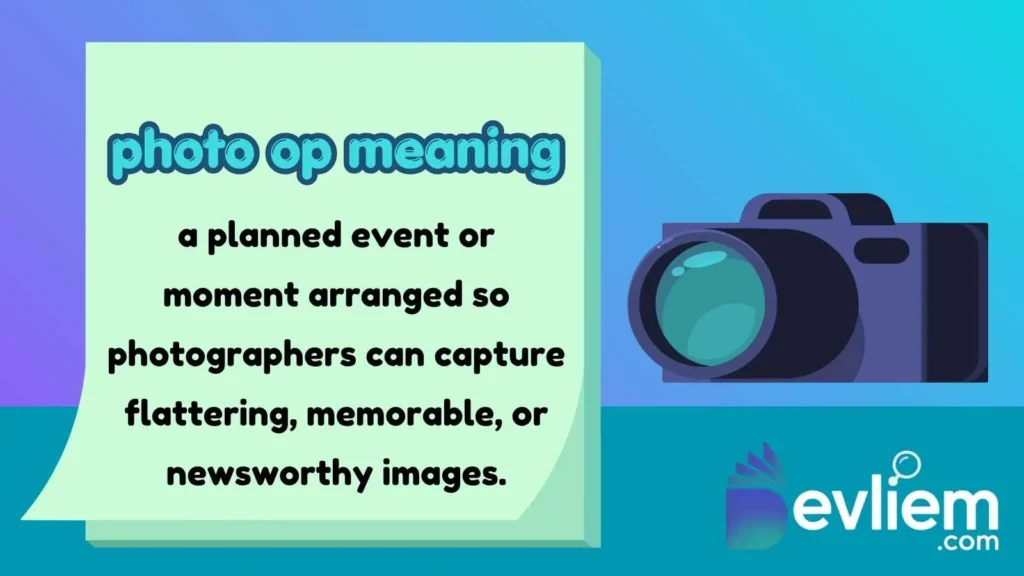
A photo op is a planned event or moment arranged so photographers can capture flattering, memorable, or newsworthy images.
It’s short for photo opportunity.
Originally, the term became common in journalism and political reporting in the mid-20th century. Reporters used it to describe staged moments created for newspapers and TV cameras.
Today, the meaning has expanded. It can refer to:
- Political publicity moments
- Celebrity appearances
- Corporate charity events
- Influencer backdrops
- Tourist spots perfect for Instagram
Quick Answer
‘Photo op’ meaning: a staged or convenient chance for photos, usually to gain publicity, attention, or positive image coverage.
Pronunciation
FOH-toh op
How to Use “Photo Op” Correctly in Texts & Chat
The phrase is usually casual and often slightly sceptical.
Common Tone Meanings
- Neutral: “They set up a photo op after the ribbon cutting.”
- Sarcastic: “Wow, planting one flower for the cameras? Total photo op.”
- Playful: “Come here, sunset photo op!”
Platform-Specific Use
SMS / WhatsApp
Used casually among friends.
Example: “Wait before eating—this is a photo op.”
Used for aesthetic locations or posed moments.
Example: “Found the perfect beach photo op.”
X / Twitter
Often used politically or critically.
Example: “Another empty photo op with no real policy.”
Discord / Reddit
Used humorously or cynically.
Example: “The guild leader only joined for the victory screenshot photo op.”
When NOT to Use It
Avoid it in highly formal business writing unless relevant.
Instead of:
“We arranged a photo op for stakeholders.”
Use:
“We scheduled a media photo session.”
Real Conversation Examples Using “Photo Op”
Between Friends
Alex: Don’t touch your coffee yet.
Maya: Why?
Alex: This latte art is a photo op.
Meaning: The drink looks so good it deserves a picture first.
Dating Scenario
Sam: Stand by the flowers.
Nina: Why?
Sam: Total photo op right now.
Meaning: A cute, romantic moment worth photographing.
Family Chat
Mom: Everyone wear matching sweaters.
Dad: Uh oh… family photo op.
Meaning: A planned family picture moment.
Work Chat
Manager: CEO arrives at 2 PM. Be ready near the new sign.
Employee: Sounds like a photo op.
Meaning: A staged corporate image moment.
Gaming Chat
Player 1: Boss defeated!
Player 2: Everyone gather in the centre of the map for a photo op.
Meaning: Screenshot celebration moment.
Common Mistakes & Misunderstandings
1. Thinking It Always Means Photography Event
Not exactly. It usually implies strategy, publicity, or staging—not just random pictures.
2. Assuming It’s Always Negative
Wrong. Sometimes it’s neutral or fun.
Example: “That rooftop mural is a great photo op.”
No sarcasm there.
3. Confusing Older vs Younger Usage
Older generations may connect it mainly with politics. Gen Z may use it for Instagram spots, brunch tables, or vacation scenes.
How to Clarify
If someone looks confused, say:
“I mean, it’s a perfect moment or setup for taking photos.”
“Photo Op” Across Different Platforms & Demographics
Gen Z
Uses it casually for aesthetic scenes, outfits, cafes, vacations, and pets.
Example: “This bookshop staircase is such a photo op.”
Millennials
Use it both socially and politically.
Older Generations
Often associate it with politicians, news conferences, and PR events.
TikTok
Used in comments for staged content.
Example: “This proposal feels like a photo op.”
Common for travel spots and décor.
Discord / Gaming
Used jokingly for screenshots.
Safe for Work?
Usually yes. It’s informal but widely understood.
Related Slang, Abbreviations & Alternatives
| Term | Meaning |
|---|---|
| PR stunt | Publicity move meant to attract attention |
| Publicity stunt | Dramatic act for media coverage |
| Media moment | Event designed for cameras |
| Staged | Planned to look natural |
| Viral bait | Content made to go viral |
| Clout chase | Seeking attention or status |
| Soft launch | Subtle reveal online |
| Main character moment | Dramatic spotlight moment |
| Insta-worthy | Great for Instagram photos |
| Camera-ready | Prepared to be photographed |
Learn more about PR stunt meaning
Learn more about clout chase meaning
Learn more about soft launch meaning
FAQs:
What does ‘photo op’ mean in politics?
It usually means a staged event where politicians pose for cameras to improve public image or gain positive press.
Is ‘photo op’ an insult?
Not always. But it can sound critical if it suggests someone cares more about photos than real action.
Can a photo op be positive?
Yes. People use it positively for beautiful scenery, parties, weddings, and travel locations.
What is the difference between a ‘photo op’ and a ‘photo opportunity’?
They mean the same thing. ‘Photo op’ is the shorter, more casual version.
Is ‘photo op’ still commonly used in 2026?
Yes. It remains popular in politics, entertainment, and social media culture.
Conclusion:
The simple photo op meaning is a planned chance to be photographed, often for publicity, image, or attention.
Sometimes it’s serious politics. Sometimes it’s just your friend posing beside a neon wall before brunch.
Once you know the term, you’ll start spotting photo ops everywhere. Drop your favourite text abbreviation in the comments below and explore more slang next.

Hi, I’m Emily Taylor, the voice behind Devliem.com, where meanings aren’t just explained, they’re made easy to understand.
I’ve always been fascinated by words, the way they change, evolve, and sometimes confuse us more than they should. That curiosity turned into a mission: to break down complex meanings, trending slang, and everyday expressions into something clear, simple, and actually useful.